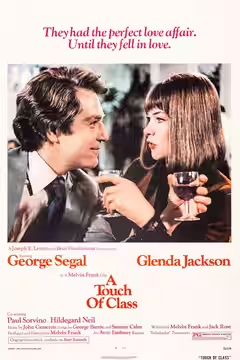
Glenda Jackson played women who had already heard the line and were deciding whether to let the man say it. It made her formidable in drama, and in A Touch of Class it made her funnier than the film around her.
Fi1m perspective
The look comes first. In A Touch of Class (1973) Vicki Allessio listens to George Segal's Steve with a face that says she has heard the line before and is deciding whether to let him have it anyway, and then she answers in a level voice, as if reading him a bill. Jackson did this in everything. She let you see the thinking before the speaking, and the thinking was usually a step ahead of whoever she was talking to. Critics called it intelligence, and it came with an abrasiveness that did not care whether it was liked.
She came from the stage and did not soften for the camera. Peter Brook's Marat/Sade (1967) filmed the Charlotte Corday she had played with the RSC, and Ken Russell's Women in Love (1969) gave her Gudrun Brangwen and a physical directness British films were not used to from their leading women. Russell used her five times. John Schlesinger cast her as Alex Greville in Sunday Bloody Sunday (1971) despite doubts at the time that she would be too strident for it, and she was not. The same year she played Elizabeth I twice, in the BBC's Elizabeth R and in Mary, Queen of Scots, and the queen fitted her: a woman who has to be cleverer than every man at court and does not hide it. That decade is the case for her. In 1992 she stopped acting, and did not come back for twenty-three years.
The comedy is where the argument is. Some critics hold that it was never her line and that A Touch of Class proves it. We scored the film 66 and think the opposite: the film is the weak thing, not her. Melvin Frank and Jack Rose wrote Vicki the rudest dialogue, and she says it with the practical air she brings to copying other people's frocks, and that is the joke for as long as the script keeps it up. When she loses her temper in the Málaga hotel room, we laughed harder than at anything else in the film, because she does not do comic rage; she does the real thing, full and undignified, on two narrow beds and a hard tiled floor, and the comedy is that Segal has nowhere to stand. The second half goes soft and gives her less to do. That is the film's fault.
The return, from 2015, was mostly on stage, with King Lear in 2016 and again in 2019, and on television in Elizabeth Is Missing, before her death in 2023. She said in 2019 that the job was "trying to find always the reality of being a human being as opposed to being a character in a play", which is a fair account of what she had been doing since the sixties. Start with Women in Love for the force and A Touch of Class for the wit. Either way, watch what she does before she speaks.
Biography
Glenda Jackson was an English actress and politician. She trained at the Royal Academy of Dramatic Art (RADA) and made her professional stage debut in the late 1950s.
She won Academy Awards for Best Actress for her roles in Women in Love (1970) and A Touch of Class (1973), in which she played Vicki Allessio. Other notable film roles include Sunday Bloody Sunday (1971), Mary, Queen of Scots (1971) and Hopscotch (1980). She received two Primetime Emmy Awards for portraying Elizabeth I in the BBC series Elizabeth R (1971) and a further Emmy and BAFTA for Elizabeth Is Missing (2019). Jackson was appointed CBE in 1978.
She served as a Labour Party Member of Parliament for Hampstead and Highgate (later Hampstead and Kilburn) from 1992 to 2015. Jackson later returned to acting, winning a Tony Award for Three Tall Women (2018) and receiving an Olivier Award nomination for King Lear (2016).