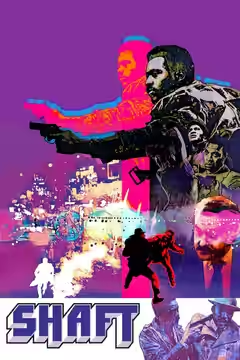
Gordon Parks puts Black lives at the centre of his films and makes their surroundings worth looking at. We value that attention to people and places, though Shaft needs a better plot to match its leading man.
Fi1m perspective
New York keeps our attention in Shaft (1971), even when the detective story has little left to offer. Parks and cinematographer Urs Furrer make it feel inhabited beyond the business of the plot, allowing ordinary life to count alongside the leading man. This is a good crime film with a substantial weakness: the writing does too little with the mob’s claim on Harlem. Parks’s experience as a photographer helps explain that attention to place, but Furrer deserves credit for how well it works here.
His first studio feature, The Learning Tree (1969), was more personal than the crime films that followed. Adapted from his semi-autobiographical novel, its coming-of-age story takes place in 1920s Kansas, and Parks served as writer, director, producer and composer. It made him the first African American to direct a major Hollywood studio feature. Shaft, its 1972 sequel and The Super Cops (1974) then took him towards more conventional action and crime stories.
Richard Roundtree explains much of the appeal of that move. We enjoyed his refusal to make John Shaft agreeable, because his guarded performance makes the Black private eye’s independence convincing. Parks gives that reserve time and attention, though we sometimes wanted more humour or a less guarded response. Isaac Hayes’s music helps make the film worth an evening, but neither actor nor score can do the writing’s job. There is enough pleasure in the performance, the music and the city to recommend it, without pretending the detective story works better than it does.
That turn towards crime did not exhaust his interest in Black lives. Leadbelly (1976), about blues musician Huddie Ledbetter, and the television film Solomon Northup’s Odyssey (1984), adapted from Twelve Years a Slave, belong beside The Learning Tree when considering the work. They take him back towards biographical and historical stories, away from the private eye whose presence can make the rest of his film-making easy to overlook. We would still begin with Shaft, provided an ingenious mystery is not the chief requirement.
Biography
Gordon Parks (1912–2006) was an American photographer, writer, composer and film director. He became the first African American staff photographer at Life magazine in 1948 and later turned to directing, becoming the first Black director of a major Hollywood studio feature with The Learning Tree (1969), which he also wrote and scored.
His best-known film, Shaft (1971), was a commercial success that helped launch the blaxploitation genre. He directed its sequel, Shaft's Big Score! (1972), as well as The Super Cops (1974) and Leadbelly (1976).