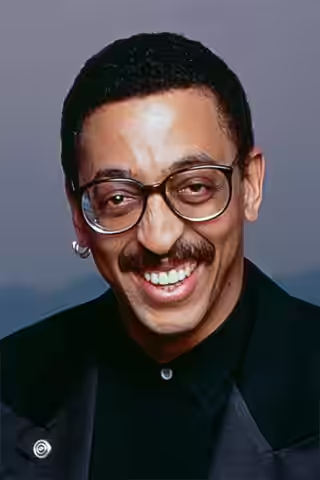
Gregory Hines brings a dancer’s physical ease to characters who need not be dancing. We value his warmth and his willingness to look vulnerable, though an agreeable presence can only do so much for an underwritten part.
Fi1m perspective
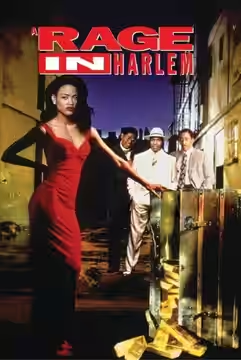
In A Rage in Harlem (1991), Gregory Hines’s Goldy belongs to the company we want to stay with, even when the crime comedy loses its way. Hines is an actor we readily warm to, and the pleasure is not confined to his dancing. We enjoyed his company here because he remained engaging through stretches of busy plotting with little comic surprise. With Danny Glover as Easy Money, he helps Bill Duke keep an uneven film worth watching. That is useful work, though it asks less of him than we might wish.
His film career began with History of the World: Part I (1981) and Wolfen (1981), before the mid-1980s gave him more substantial screen opportunities. Francis Ford Coppola’s The Cotton Club (1984) put him alongside his brother Maurice, while White Nights (1985) paired him with Mikhail Baryshnikov. Those partnerships matter: Hines’s loose, low-to-the-ground tap style could stand beside ballet without trying to resemble it. Then Running Scared (1986), opposite Billy Crystal, gave him a buddy-cop lead that did not depend primarily on dance.
His physical expressiveness comes with a gentleness that is attractive but can become a limitation. He sought parts that allowed Black men vulnerability, including roles originally written for white actors, rather than accepting the cool, untroubled figure as his lot. Tap (1989) brought him together with Sammy Davis Jr. and older tap performers, but its predictable plotting makes the stretches between dances less rewarding. His agreeable manner cannot make those scenes sufficiently interesting on its own.
A Rage in Harlem shows both the value and the limit of that friendliness. Forest Whitaker and Robin Givens provide much of its charm, and Hines and Glover help sustain it; none of them can supply the missing comic invention. We would not confuse a welcoming supporting performance with a fully rewarding part. For a fuller introduction, start with Running Scared, where Hines gets the responsibility of a lead rather than the job of making weaker stretches agreeable.
Biography
Gregory Oliver Hines (14 February 1946 – 9 August 2003) was an American tap dancer, actor, choreographer and singer. He began tap dancing at the age of two or three and performed professionally from the age of five with his older brother Maurice as the Hines Kids, later joined by their father as Hines, Hines and Dad. He made his Broadway debut in 1954.
Hines appeared in more than 40 films, including History of the World: Part I (1981), The Cotton Club (1984), Running Scared (1986) and A Rage in Harlem (1991), in which he played Goldy. On television he had a recurring role as Ben Doucette on Will & Grace (1999–2000) and voiced Big Bill on the animated series Little Bill (1999–2004). He also performed on Broadway, winning a Tony Award and a Drama Desk Award for Jelly's Last Jam (1992). He received a Daytime Emmy Award and was nominated for four Primetime Emmy Awards and a Screen Actors Guild Award.