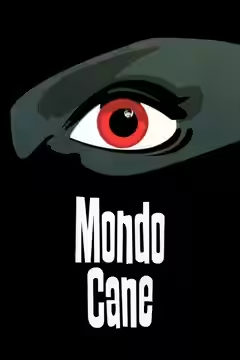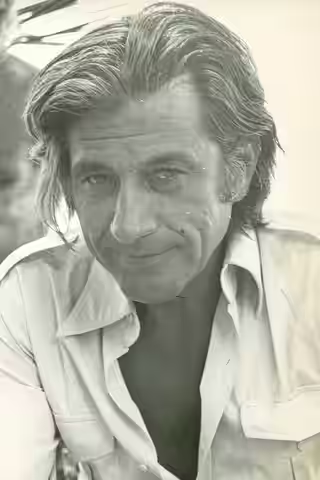
Jacopetti invented the mondo film and edited it better than anyone who copied him. The cutting in Mondo Cane (1962) is quick, witty and always aimed at the audience, and the contempt underneath it is the reason we cannot recommend the results.
Fi1m perspective
Californians weep at a pet cemetery in Pasadena. Cut to a restaurant where dogs hang from hooks. That is Jacopetti's cinema in two shots: set up the joke, deliver it, move on before anyone can object. He edited Mondo Cane (1962) himself, and he was better at the cut than anyone who copied him, which is the main reason the film is still watched and the imitators are not. Riz Ortolani's tune sits under it, far kinder than the pictures, so the cruelty arrives with a pleasant melody attached.
He came out of newsreels, and it shows. A newsreel is footage with a voice on top telling you what it means, and every film he made is that, at feature length and with worse manners. In 1960 he proposed what he called an anti-documentary to Franco Prosperi and Paolo Cavara, and Mondo Cane was the result. Mondo Cane 2 and Women of the World followed in 1963, then Africa Addio (1966) with Prosperi, shot across Africa in the middle of decolonisation, then Goodbye Uncle Tom (1971), which gave up found footage and reconstructed American slavery inside a faux-documentary frame. Mondo candido (1975), a modern Candide, was the last substantial one and the last with Prosperi, and after it he went back to journalism. Antonio Climati shot most of these; Angelo Rizzoli paid for them.
The method works; the temper behind it is the problem. Every cut in Mondo Cane lands the same punchline, that you think you are better than these people and you are not, and by the fifth time the wit has become a lecture. We came out of it feeling handled: told at every join what to think, and resenting it even when the join was clever, because the film plainly held us in the same low regard as the villagers and the mourners on screen. The intelligence is real. It has simply decided the whole species is beneath it, audience included.
We have not reviewed the later films and will not judge them at length. We will say that critics of the time found Africa Addio and Goodbye Uncle Tom brutal, dishonest and contemptuous of the people in them, and that he was accused of staging scenes presented as found, which he denied for every film but Mondo Cane 2.
His rule, as he put it years afterwards, was "Slip in, ask, never pay, never reenact." It is a good rule for a newsreel man. By 1971 he was reconstructing the nineteenth century on a set, so he broke the last part of it himself, and the film he made while he was still keeping it is the only one we would point you towards, and only with the warning already on its page.
Biography
Gualtiero Jacopetti was an Italian documentary film director, screenwriter and editor. Born in Barga, Tuscany, in 1919, he worked as a journalist after the Second World War before moving into newsreels and then feature films.
With Paolo Cavara and Franco Prosperi, he originated the mondo film genre, also known as shockumentaries. Their first collaboration, Mondo Cane (1962), was a compilation of unusual and often shocking footage from around the world; Jacopetti served as director, writer, editor and producer. The film premiered at Cannes and inspired a wave of similar productions.
Jacopetti continued in the genre with films including Africa Addio (1966) and Goodbye Uncle Tom (1971). He died in Rome in 2011.