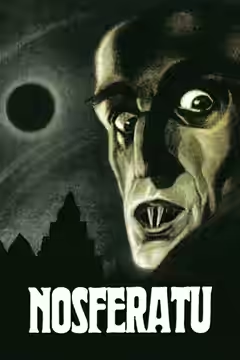
Gustav von Wangenheim gives Nosferatu a vulnerable human witness, but we find his insistent cheerfulness tiring. His romantic-lead background helps explain Hutter’s innocence; it does not excuse a performance that keeps telling us what we already know.
Fi1m perspective
Gustav von Wangenheim’s Hutter has made his cheerfulness clear, and is still busy making it clear. In F. W. Murnau’s Nosferatu (1922), the gestures keep coming after the opening has established all the good spirits it needs. We grew impatient because the performance kept insisting on a mood we had already understood. It is a distracting weakness in a film we rate highly, and one that makes its ordinary human company less appealing than it should be.
Young romantic leads in silent comedies and dramas were a recurring part of his work, which makes Hutter’s initial good spirits easier to place. He played Romeo in Ernst Lubitsch’s Romeo und Julia im Schnee (1920) and Paul Seppl in the same director’s Kohlhiesels Töchter (1920). Fritz Lang later cast him as the engineer Hans Windegger in Woman in the Moon (1929). His subsequent work included Der Kampf (1936) and ... und wieder 48 (1948), both as writer and director. Those credits take him beyond acting, but Nosferatu remains the clearest place to consider what he offers on screen.
Hutter’s vulnerability does useful work, though: an estate agent facing the supernatural gives the horror someone recognisably ordinary to threaten. His growing alarm is easier to accept than his cheerfulness because there is a clear reason for it. Max Schreck’s Count Orlok is frightening enough to justify a conspicuous reaction. Von Wangenheim is less persuasive when the acting insists on our attention while Murnau’s carefully framed spaces are already doing enough.
Greta Schröder’s Ellen supplies the comparison that matters: her watchfulness allows anxiety to stay in a look, where von Wangenheim is more inclined to a gesture. The contrast makes it hard to excuse his excesses simply as the acting style of a silent film. We need to believe in Hutter’s vulnerability, but we do not need every feeling explained at such length. Start with Nosferatu, and allow the opening more patience than its leading man makes easy.
Biography
Gustav von Wangenheim was a German actor, screenwriter and director. Born Ingo Clemens Gustav Adolf Freiherr von Wangenheim on 18 February 1895 in Wiesbaden, he trained at the Max Reinhardt school of acting at the Deutsches Theater in Berlin and made his screen debut in 1914.
He is best known for playing Thomas Hutter in F. W. Murnau's Nosferatu (1922) and Hans Windegger in Fritz Lang's Woman in the Moon (1929). He appeared in numerous other silent films in the 1920s and was a member of the Communist Party of Germany from 1921. After the Second World War he returned to East Germany, where he worked as a director and screenwriter for DEFA.