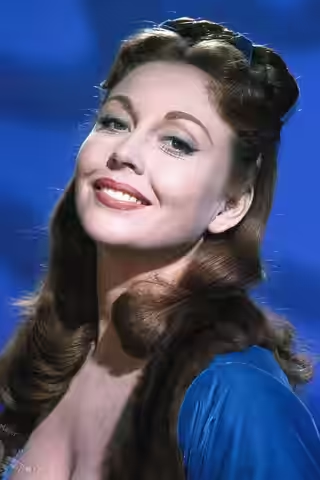
Hazel Court played the woman who wanted something in films where most women were only waiting to scream, and she played it straight. In cheap gothic horror on both sides of the Atlantic, she is often the one person who never lets on that it is silly.
Fi1m perspective
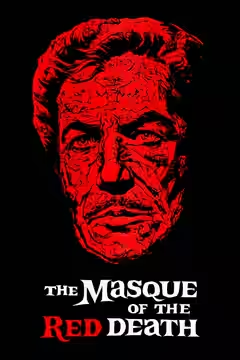
In The Masque of the Red Death (1964), Hazel Court's Juliana asks Vincent Price's Prospero to initiate her into his faith. She is not tricked into it and she is not dragged. She wants it, and Court plays the wanting without a flicker of apology, so that when the dream arrives, masked figures in one costume after another each meaning to kill her, we are watching a woman get what she asked for. That sequence, cut by Ann Chegwidden, is short, fast and nearly wordless, and it frightened us outright. It is the one stretch of the film that did, and Court is a large part of why: she never signals that any of this is ridiculous.
That was her habit. She was cast again and again, in British and then American horror, as the woman who is not the victim, or not only the victim: the jealous mistress, the ambitious fiancée, the one standing beside a powerful and unpleasant man and declining to shrink. She said of it later, "I think, that I always played with great conviction. When I did all these horror films, I did not camp around." That is a fair account of what is on screen.
She began in British films in the mid-1940s, in small and uncredited parts, after training in Birmingham repertory and with the Rank Organisation's Company of Youth. The turn came at Hammer. In The Curse of Frankenstein (1957), Terence Fisher's first colour horror for the studio, she played Elizabeth, the fiancée, alongside Peter Cushing and Christopher Lee, and she was back with Fisher two years later for The Man Who Could Cheat Death (1959), opposite Anton Diffring. By the early 1960s she was in America, where Roger Corman put her in three Edgar Allan Poe adaptations in a row: The Premature Burial (1962), in which she did her own burial scene; The Raven (1963), with Price, Boris Karloff and Peter Lorre, the one Corman played for laughs and the one she later called a favourite; and The Masque of the Red Death, her last major film role. Around them she guested on American television, Alfred Hitchcock Presents, The Twilight Zone, Bonanza, Mission: Impossible, Mannix, and by the early 1970s she had largely stopped.
The reservation with Court is rarely about Court. The films were made cheaply and some of them are kitsch, and she is frequently the most serious thing in them. That is a virtue and a limit. In The Curse of Frankenstein the film needs the fiancée to be believed, and she is; in The Masque she is given more to do than anywhere else, and it is the best of them. She was stronger as the woman who wanted something than as the one waiting to be rescued, and the films did not always know which they had hired.
Start with The Masque of the Red Death. Corman and Nicolas Roeg hand her a castle painted one colour at a time and a dream that means to kill her, and she does not wink at either.
Biography
Hazel Court (10 February 1926 – 15 April 2008) was an English actress. She appeared in British films from the mid-1940s and became known for roles in horror films of the 1950s and early 1960s, including The Curse of Frankenstein (1957).
Court later worked in the United States. She appeared in three Roger Corman adaptations of Edgar Allan Poe stories: The Premature Burial (1962), The Raven (1963) and The Masque of the Red Death (1964), in which she played Juliana. Her television credits include episodes of Alfred Hitchcock Presents, The Twilight Zone, Bonanza and Mission: Impossible.
She trained at drama schools in Birmingham and made her film debut in Champagne Charlie (1944). Court was married to the actors Dermot Walsh and Don Taylor.