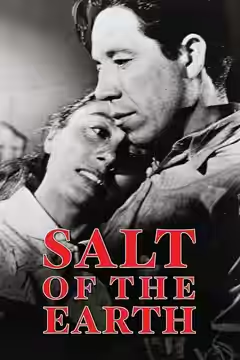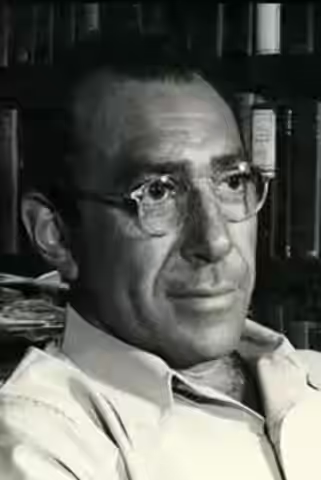
Herbert J. Biberman makes working people worth watching, especially when they disagree among themselves. We rate Salt of the Earth for its feeling and its attention to women’s demands, though its speeches sometimes crowd the characters out.
Fi1m perspective
In Salt of the Earth (1954), the miners and their families have a way of speaking and moving that helps the film through its stiffer passages. Biberman mixes local non-professionals with professional actors, giving the group a convincing life beyond the speeches. The workers have disagreements as well as grievances, and he makes those worth attending to. We think it is good, uneven work, with a seriousness about ordinary people that earns our patience.
Biberman had directed studio features, including One-Way Ticket (1935) and The Master Race (1944), before making Salt of the Earth independently. Its account of a real New Mexico miners’ strike put a community, and divisions within it, at the centre of the drama. He later directed Slaves (1969), with Ossie Davis and Dionne Warwick, returning to social conflict through slavery and resistance. Our recommendation rests chiefly on Salt of the Earth, where the women’s demands for equality within the union complicate the workers’ common cause.
With screenwriter Michael Wilson and producer Paul Jarrico, Biberman gives those internal disagreements a substantial place in the film. The men have to consider how fairly they treat the women alongside them, which makes their struggle more difficult and more interesting. We were moved by Rosaura Revueltas, because she makes the women’s demands feel personal when the speeches risk turning them into a lesson. Her performance gives us someone to care about through the stretches when the dialogue becomes too instructional.
The trouble comes when Biberman seems to regard a firmly stated principle as sufficient drama. At times, a speech does the work that a character’s behaviour might have done, and the people have less room to be awkward or surprising. His certainty leaves little opportunity for us to work things out for ourselves. That is a limitation worth acknowledging in a film whose treatment of working people otherwise deserves respect. See Salt of the Earth for Revueltas and the life of the group, with some patience for the speeches.
Biography
Herbert J. Biberman (4 March 1900 – 30 June 1971) was an American screenwriter and film director. He directed and produced the independent film Salt of the Earth (1954), about a zinc miners' strike in New Mexico.
Biberman was one of the Hollywood Ten, convicted of contempt of Congress in 1947 after refusing to testify before the House Un-American Activities Committee; he served a six-month prison sentence. His earlier career included writing films such as King of Chinatown (1939), Action in Arabia (1944) and New Orleans (1947), and directing Meet Nero Wolfe (1936) and The Master Race (1944). He later wrote and directed Slaves (1969).
He was born in Philadelphia to Joseph and Eva Biberman, and married actress Gale Sondergaard in 1930. His membership in the Directors Guild of America was restored posthumously in 1997.