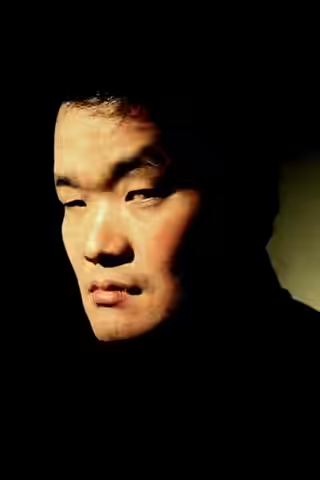
Hideo Nakata makes ordinary rooms and familiar technology feel unsafe, giving us time to imagine what might happen. We rate his patient horror highly, though Ring also shows how easily an investigation can become a chore.
Fi1m perspective
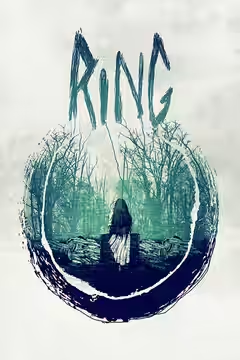
In Ring (1998), a cursed videotape comes with a one-week deadline, and Nakata lets that knowledge do much of the frightening work. He gives us time to look without continually prompting us to be alarmed. We were frightened by the waiting: the deadline stays in mind even when the investigation slows. That patience is his strength, though it asks for more concentration than the detective work always repays.
Don’t Look Up (1996) had already linked film stock with the paranormal before Ring established Nakata in J-horror. Screenwriter Hiroshi Takahashi was an important early collaborator, and Ring draws on Kōji Suzuki’s novel. Nakata makes film and video themselves seem suspect, without needing graphic violence. His restraint helps because he leaves us room to worry for ourselves, rather than supplying a fresh shock at every opportunity.
His long-standing collaboration with cinematographer Jun’ichirō Hayashi includes Ring, Dark Water (2002) and Kaidan (2007). Water and recorded images recur in Nakata’s work, but so do women facing isolation or neglect. Dark Water brings parental anxiety and institutional neglect into its ghost story, giving the fear a melancholy that fits the domestic setting. It is the next film we would try after Ring, for the attention paid to family strain as much as the haunting.
The sequels took him from Ring 2 (1999) to The Ring Two (2005), his English-language Hollywood debut and a sequel to the American remake. That film’s muddled narrative and uneven effects expose problems that a restrained director cannot simply wait out. Nakata has also worked across thrillers, dramas and documentaries. We would be wary of treating every return to horror as a return to the assurance of Ring.
For a starting point, we would still choose Ring, with a little tolerance for the detective work. The curse and the prospect of a cure supply enough urgency; the explanations sometimes make following it harder than it needs to be. Its quiet stretches deserve attention. Save it for an evening when nobody intends to talk through them.
Biography
Hideo Nakata (中田 秀夫) is a Japanese film director. Born on 19 July 1961 in Konkō, Okayama, he trained as an assistant director at Nikkatsu and Toei studios before making his directorial debut with the television anthology Curse, Death & Spirit (1992). His first theatrical feature was Don't Look Up (1996).
Nakata is best known for directing Ring (1998), an adaptation of Kōji Suzuki's novel that helped popularise J-horror internationally. He also directed its sequel Ring 2 (1999) and Dark Water (2002). Later credits include the Hollywood film The Ring Two (2005), Death Note: L Change the WorLd (2008), Chatroom (2010) and THE DAYS (2023). He has additionally made documentaries, including one on Joseph Losey.