Hiroshi Teshigahara made films in which the surroundings do most of the acting: sand and skin. Four of them, written with Kōbō Abe in the 1960s, are the reason to know his name, and one of them is close to essential.
Fi1m perspective
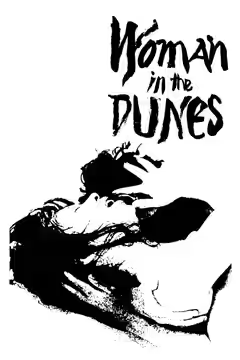
A stream of sand runs off a roof beam onto a sleeping face. Sweat on a man's forehead collects a crust; he wipes it away and it collects again. That is Woman in the Dunes (1964), and it is how Hiroshi Teshigahara worked: he wanted you to feel a place on your skin before he let you think about what it meant. Hiroshi Segawa shoots the dunes from above so the ridges look like skin under a magnifying glass, then shoots skin so close it looks like dunes. We came out wanting a shower, and we meant it as praise.
He trained as a painter, graduating in oil painting in 1950, and began with short documentaries in the early 1950s; the eye of someone used to arranging objects and flowers never left him. The features began with Pitfall (1962), his first film with the novelist Kōbō Abe and the composer Tōru Takemitsu, and ran on through Woman in the Dunes, The Face of Another (1966) and The Man Without a Map (1968): four films with Abe about people who lose their names, their faces or their way. Summer Soldiers (1972), about American deserters in Japan, broke the pattern, and then he more or less stopped. For nearly two decades he made ceramics, arranged flowers, mounted exhibitions and shot documentaries, among them Antonio Gaudí (1984). He came back with Rikyu (1989) and Princess Goh (1992), and died in 2001.
What works is the company he kept. Abe gave him plots that fit in a sentence and ideas that do not. Takemitsu scored five of his films. Segawa shot three. Kyōko Kishida and Eiji Okada, the widow and the collector in the pit, each worked with him twice, and he directed them toward stillness, treating Okada less as a person than as a specimen. Teshigahara said the sandpit 'symbolizes society itself', and the film is better than that sounds because he never stops to say so on screen. What has aged less well is the abstraction: The Face of Another is the one whose modernist surface is said to have dated fastest, and the late historical films are called stately, which is the polite word for slow. Even his admirers rest the case on a handful of films from one decade.
That does not trouble us much. Plenty of directors make forty films nobody can tell apart; Teshigahara made a few that stay. Woman in the Dunes moved us more than we expected, not in the scene at the tin basin where she washes the sand from his back, but in the way the weeks pass and what is between the two of them changes and nobody, least of all Teshigahara, tells us what to make of it. Start there. It runs 147 minutes and the plot takes one sentence. If that does not put you off, the other three Abe films are waiting, and they will show you how much a novelist, a composer and a painter who turned to film could make together in six years.
Biography
Hiroshi Teshigahara (28 January 1927 – 14 April 2001) was a Japanese filmmaker and artist. He was born in Tokyo, the son of Sofu Teshigahara, founder of the Sogetsu School of ikebana. He graduated in 1950 from the Tokyo National University of Fine Arts and Music and began working in documentary film.
Teshigahara directed his first feature film, Pitfall (1962), in collaboration with author Kōbō Abe and musician Tōru Takemitsu. He continued the partnership on Woman in the Dunes (1964), which received an Academy Award nomination for Best Foreign Language Film and won the Special Jury Prize at the Cannes Film Festival, and on The Face of Another (1966). He later directed Summer Soldiers (1972).
From the mid-1970s he worked less frequently on feature films, concentrating on documentaries, exhibitions and the Sogetsu School, of which he became grand master in 1980.