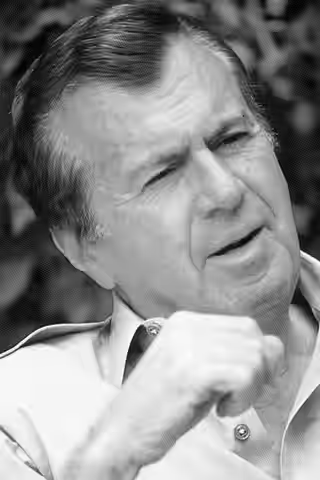
Howard Zieff came to features from advertising, and his comedies are built the way good commercials are: a face, a small precise gag, an indirect sell. It works for an hour at a time; sustaining it across a whole film was the harder trick.
Fi1m perspective
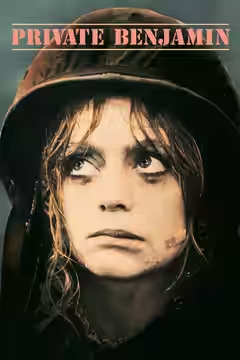
Judy Benjamin, who has never carried her own luggage, is made to carry everything. That stretch of Private Benjamin (1980), from the recruiting office to roughly the hour mark, is Howard Zieff at his best, and it tells you how he worked. The jokes are not new; basic-training comedy was old when he got to it. What he adds is small and exact: a look, a prop, the length of the pause before Goldie Hawn says the thing. We laughed a good deal in that barracks, more than the material had any right to earn, and nearly all of it was timing.
The timing came from somewhere. Zieff spent the 1960s as an advertising photographer and a director of television commercials, more than two hundred of them, among them the Alka-Seltzer spicy meatball spot, and he was known for the humorous campaign and the indirect sell. He cast ordinary faces rather than models and shot everyday situations. He sold his company in 1969, made his first feature, Slither, in 1973, and directed eight more comedies up to 1994: Hearts of the West (1975), often taken as his most assured film, Private Benjamin, a remake of Unfaithfully Yours (1984), the ensemble farce The Dream Team (1989) and My Girl (1991), the family picture that became his best-known later work. Nine comedies in twenty-one years, and nothing else.
The method has a ceiling, and Private Benjamin shows where it is. A commercial is thirty seconds, a vignette is a scene, and a feature needs a shape, which Zieff was never much interested in. Once Judy is posted out of the camp the film goes soft and loses most of its jokes, and we felt it go, the way you feel a car change down. Nothing is wrong with any single scene. There are simply fewer reasons for the scenes to follow one another. The usual reservations about the later work, that My Girl leans on sentiment and that the Sturges remake is coarser than the original, point at the same thing. He trusted the moment and let the structure look after itself.
What he did have was actors, and he knew it. He said comedy direction meant hiring somebody who already had the talent and then letting "the actors give you the gifts of embroidery", and he kept his sets relaxed enough for them to do it. Hawn is the proof: funny and watchable for every one of Private Benjamin's 110 minutes, including the fifty or so the film does not deserve her. He went back to Dan Aykroyd and Jamie Lee Curtis for a second film each, and to the cinematographer David M. Walsh and the editor Sheldon Kahn, which suggests a director who understood that the gag was theirs to deliver and his to set up.
Start with Private Benjamin. The first hour is the case for him and the second is the case against, and they were made by the same man with the same star in the same year, which is the plain fact about Zieff: his strengths and his limits never turned up in different films.
Biography
Howard Zieff was an American film director. He began his career as an advertising photographer and director of television commercials in New York during the 1950s and 1960s, creating campaigns for brands including Alka-Seltzer and Levy's rye bread.
Zieff made his feature debut with the comedy Slither (1973). He went on to direct Hearts of the West (1975), House Calls (1978), The Main Event (1979), Private Benjamin (1980), Unfaithfully Yours (1984), The Dream Team (1989), My Girl (1991) and My Girl 2 (1994). He retired after the last of these owing to Parkinson's disease.
Zieff was born in Chicago on 21 October 1927 and died in Los Angeles on 22 February 2009.