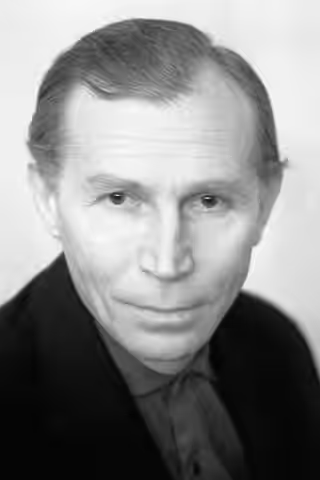
Ivan Lapikov’s plain, restrained acting is most persuasive when a character’s faults show. We recommend his Kirill in Andrei Rublev, where an envious monk’s piety remains uncomfortably believable.
Fi1m perspective
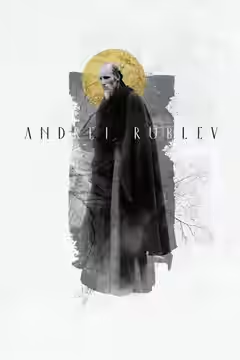
In Andrei Rublev (1966), Ivan Lapikov’s Kirill is pious and envious, with neither quality cancelling the other out. Lapikov does little to advertise the conflict, which is what makes the performance persuasive. We were unsettled by Kirill because his faith remains credible even when his envy makes him difficult company. We value that restraint: it allows an unpleasant feeling to remain recognisable without asking us to excuse it.
We recommend Andrei Tarkovsky’s film, though some of its symbolism remains stubbornly obscure. Anatoly Solonitsyn’s humanity and cinematographer Vadim Yusov’s forceful images do much to earn the attention it asks for. Lapikov’s contribution is narrower, and worth being precise about: he makes Kirill’s contradictions understandable without simplifying the man. That does not make the whole film straightforward, nor should a supporting performance have to. Kirill’s jealousy, at least, does not require an explanatory note.
The breakthrough had come with Aleksei Saltykov’s The Chairman (1964), playing Semyon Trubnikov, the chairman’s brother. It established him as a convincing presence playing flawed, ordinary men, a strength that suited the historical and wartime dramas in which he often worked. Peasants, soldiers and monks became familiar assignments, usually in supporting or episodic parts. Sergei Bondarchuk was a recurring collaborator, directing him as Sergeant Poprischenko in They Fought for Their Country (1975). The reservation is about those opportunities rather than his ability: smaller parts gave him less room to develop a character over the course of a film.
Television offered more room in The Eternal Call (1973–83), directed by Valeri Uskov and Vladimir Krasnopolski, with Lapikov taking a leading role as Pankrat Nazarov. That is a useful corrective to remembering him only for small parts. But a leading role is not required to appreciate what he does. Start with Andrei Rublev, and allow time for the film rather than waiting for Lapikov to take it over.
Biography
Ivan Lapikov (also credited as Ivan Gerasimovich Lapikov) was a Soviet and Russian actor. He was born on 7 July 1922 in Gornyy Balykley, Saratov Governorate, RSFSR (now Volgograd Oblast, Russia). After studying for two years at the Kharkov Theatre School, he worked at the Gorky Drama Theatre in Stalingrad (now Volgograd) from 1941 until 1963, when he moved to Moscow and joined the Film Actor's Theatre-Studio.
Lapikov's first screen role was in The Reserve Player (1954). He became known after appearing in The Chairman (1964) and played Kirill in Andrei Tarkovsky's Andrei Rublev (1966). Other notable film roles include Sergeant Poprischenko in They Fought for Their Motherland (1975). He was named People's Artist of the USSR in 1982 and died on 2 May 1993 in Moscow.