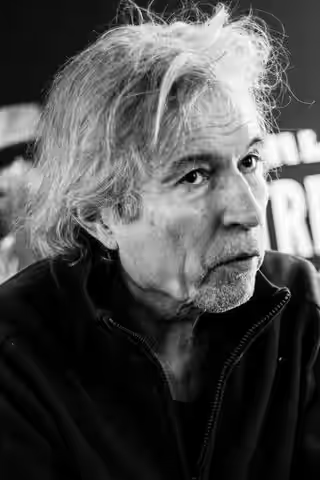
Jacques Doillon puts children and couples in a room, sets the camera at their height and lets them talk until something true comes out. With children he has few equals; with adults the talk can run on past the point.
Fi1m perspective
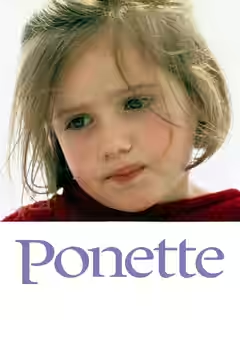
A four-year-old with her arm in a cast is told that Jesus died and rose again, and takes it as a procedure. Later a girl at school explains that you can become a child of God if you pass certain tests, and she sits them. That is the middle of Ponette (1996), and it is Jacques Doillon's method in miniature: put a child among other children, set the camera at their height, and let them argue in long takes until the adult idea has become something they can use. Mostly there is no grown-up on screen to tell us how to feel.
He came to directing from the cutting room, as an assistant editor on Alain Robbe-Grillet's Trans-Europ-Express (1966). After a co-directed first feature, L'An 01 (1973), his solo debut Les Doigts dans la tête (1974) set the pattern: youth, non-professionals, watching rather than plotting. Un sac de billes (1975) found a public, and for the next two decades he made roughly a film a year about children, adolescents and couples. Ponette was the one that travelled. Raja (2003), Rodin (2017) and CE2 (2021) have followed, all built the same way: a few people, a few rooms, a great deal of talk.
The children are what works. Doillon has said it is always to the actors he goes to find the truth of a scene, and with a four-year-old that means rehearsing to catch a reaction rather than manufacture one. In Ponette we laughed at the cousins arguing about heaven with the seriousness of lawyers, then remembered what the girl was trying to buy with all that theology, and stopped. Victoire Thivisol is not performing grief; she is somewhere inside it, and the film sits beside her. Caroline Champetier, who has shot five of his films, keeps the camera close and low, and Brune Compagnon has worked on several of the scripts, Ponette included.
The method has a cost, and it is the same cost each time. Scenes go round the loop: a child insists, the others correct her, she tries a new ritual, and in Ponette we felt it idle for a quarter of an hour. With adults the problem grows, because grown-ups given that much room talk like people who have read books, and some reviewers have found the dialogue of his adolescent and couple films, Le Jeune Werther (1993) among them, verbose and over-thought; Rodin was called mannered and short of momentum. We also came out of Ponette wondering how he got those scenes from a child that small, and whether we should be easy with it. He would say the wildness is the point and that grown actors lose it. We are not sure that settles anything.
Start with Ponette. If it holds you, the shelf behind it is long; if the children's talk wears thin, the adults will not help.
Biography
Jacques Doillon is a French film director and screenwriter. Born on 15 March 1944 in Paris, he began working in film as an assistant editor on features including Alain Robbe-Grillet’s Trans-Europ-Express (1967) before directing his first feature, L’An 01, in 1973.
He is known for films such as Ponette (1996), on which he served as director and writer, Rodin (2017), Le Petit Criminel (1990) and La Drôlesse (1979). Several of his films have screened at major festivals, including entries at Berlin where Le Petit Criminel received an Honourable Mention and Le Jeune Werther won the Blue Angel Award.