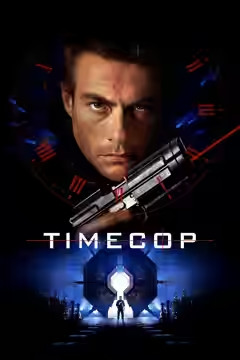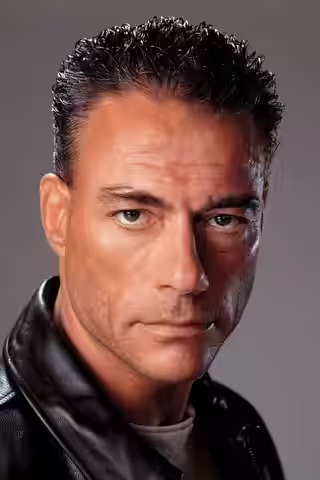
Van Damme moves like a dancer and hits like a kickboxer, and for most of his career the films around him have asked for nothing else. When a director asks for more, as Peter Hyams did in Timecop, there turns out to be more.
Fi1m perspective
Somewhere in every Jean-Claude Van Damme film there is a moment when he does the splits. He does them between two chairs, across a doorway, or, in Timecop (1994), across a kitchen worktop in the dark to keep his feet out of a puddle someone has just dropped a live wire into. The five years of ballet he took from the age of sixteen are in that move, and so is the whole appeal: a man built like a bodybuilder doing things a bodybuilder should not be able to do. The face above the legs does almost nothing. He knows it. He said himself in 2017 that he had made forty-odd films in which you see him with a gun and one neutral face, and that is a fair review of most of them.
The films came in a rush. Bloodsport (1988), with Van Damme as Frank Dux, was the first lead after years of small parts and odd jobs; Kickboxer (1989) repeated the recipe with longer fights and a training montage; Universal Soldier (1992) put him opposite Dolph Lundgren, the first of four films together, and found him an audience beyond the martial-arts crowd. Along the way John Woo, Tsui Hark and Ringo Lam each made their first American film with him, which says something about how reliably he could carry a fight a Hong Kong director would recognise. Then the late 1990s arrived, the films went straight to video, and they stayed there for most of a decade.
The weakness is the one he names. Asked to stand still and talk, he can look like a man waiting for the next kick, and the early films, with their thin plots and revenge stories told in as few words as possible, rarely asked him for anything else. Timecop is the exception we have reviewed, and it is instructive. Peter Hyams, who directed him twice, keeps the dialogue short enough that the accent stops mattering, and Van Damme plays Max Walker as a widower first and a kickboxer second. He is more watchable for it. We went in prepared to be patient with him and found, somewhere around that kitchen fight, that we had stopped being patient and started being pleased; the stillness that looks blank in a bad film reads as grief in a slightly better one.
JCVD (2008), in which he plays himself, and The Expendables 2 (2012), in which he plays a villain called Jean Vilain, brought him back into view, and the later work, including the series Jean-Claude Van Johnson (2016–2017), leans on the joke of a man who has noticed what he is. We suspect the joke suits him better than it would suit most of his contemporaries, because he was never pretending the face moved. Start with Timecop. How much further you go depends entirely on how you feel about the splits.
Biography
Jean-Claude Van Damme is a Belgian actor and martial artist. Born Jean-Claude Camille François Van Varenberg on 18 October 1960 in Berchem-Sainte-Agathe, Brussels, he trained in karate and kickboxing before moving to the United States in 1982.
He gained prominence with his lead role as Frank Dux in the 1988 martial arts film Bloodsport, on which he is also credited as editor. Subsequent films include Kickboxer (1989), Universal Soldier (1992), Timecop (1994) as Max Walker, and Street Fighter (1994). He has appeared in voice roles in animated features such as Kung Fu Panda 2 (2011) and Minions: The Rise of Gru (2022).