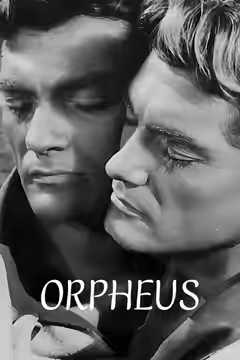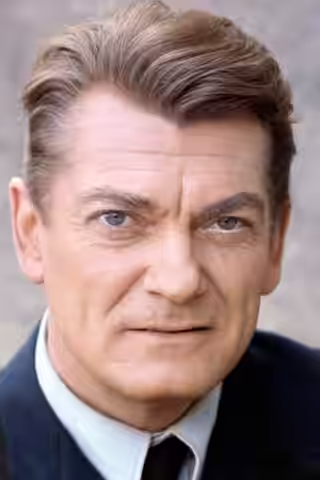
Jean Marais gives poetic fantasy an imposing human presence, though his solemnity can keep us at a distance. We value that gravity in Jean Cocteau’s films; the later swashbucklers put his considerable physical skill to more direct use.
Fi1m perspective
In Orpheus (1950), Jean Marais gives the poet a gravity that makes the supernatural seem worth taking seriously. His solemnity fits a film in which an ordinary mirror can feel unsafe. We were unsettled by that familiar object becoming threatening, and Marais’s refusal to make light of the strangeness helps it work. Cocteau needs his seriousness, even when we would welcome a little less of it.
The early leading roles were closely tied to Cocteau, who scripted Jean Delannoy’s L’Éternel retour (1943) and directed La Belle et la Bête (1946) before Orpheus. Playing several parts in the fairy tale, including the Beast under heavy make-up, gave Marais more to do than look suitably noble. From the mid-1950s, swashbucklers and action films gave his athleticism more room. André Hunebelle’s Le Bossu (1959) belongs to that turn, with Marais performing demanding stunts himself.
What Orpheus also reveals is how much Marais benefits from the right company. His reserve gives the poet stature, but the romance can feel remote, and we do not always get past the solemnity to the man. María Casares, as Death, makes the supernatural feel closer; François Périer’s Heurtebise supplies the lightness that Marais does not. Their contrast is valuable, and Cocteau’s casting allows Marais to remain grave without requiring everyone else to do the same. Périer, in particular, makes it easier to enjoy a film whose leading figures can become too imposing to care about.
Multiple roles recur in the popular films. In Fantômas (1964), Marais plays both the criminal and the journalist Fandor, taking that practice into a different sort of entertainment. His stunt work belongs in any account of his acting, alongside the restraint and the imposing presence; concentrating only on the poetic roles leaves out a substantial skill. Start with Orpheus, but do not take its brooding poet for the whole of what Marais could do.
Biography
Jean Marais (born Jean Alfred Villain-Marais) was a French actor who appeared in over 100 films and television productions. He was born on 11 December 1913 in Cherbourg and died on 8 November 1998 in Cannes.
Marais became closely associated with the work of Jean Cocteau, appearing in several of the director's films including Beauty and the Beast (1946) as the Beast and the Prince, Orpheus (1950) as Orphée, and Testament of Orpheus (1960) as Oedipe. He also starred in the Fantômas trilogy (1964–1967) and swashbuckler films such as The Hunchback of Paris (1959). In 1996 he received the French Legion of Honour for his contributions to cinema.