Jean Vigo makes room for unruly children and for everyday sights to turn strange. We recommend Zero for Conduct for its warmth and mischief, while wishing he had joined its pleasures together more firmly.
Fi1m perspective
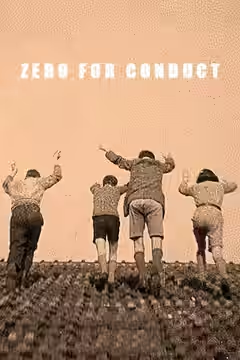
In Zero for Conduct (1933), the boys’ wish to play gets more attention than their lessons. Vigo writes and directs from their side, without treating obedience as proof that a child is worth caring about. We felt cheered by the boys’ unruliness because he lets us enjoy it without waiting for an adult to approve. That warmth keeps the film companionable even when its construction is rough.
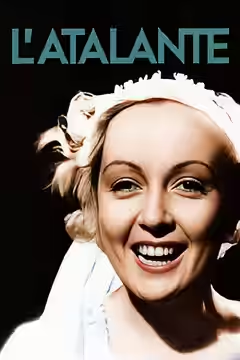
He made four films between 1930 and 1934, moving from documentary shorts to fiction. À propos de Nice (1930), his self-financed debut, observes a city and contrasts comfortable leisure with the life around it. The commissioned swimming portrait Taris (1931) experiments with slow motion and underwater images. After the school rebellion of Zero for Conduct, his only feature, L’Atalante (1934), follows a newly married couple on a barge. Its location shooting and dreamlike passages continue his habit of looking closely at ordinary life, then allowing it to become strange.
Boris Kaufman was the cinematographer on all four films. Vigo uses slow motion, dissolves and inventive cutting to move beyond straightforward observation, but the editing does not always serve him well. On Zero for Conduct, he was writer, director, producer and editor, with financing from Jacques-Louis Nounez. Of those jobs, it is his editing that gives us most cause for complaint.
At 48 minutes, Zero for Conduct still leaves us wanting firmer connections between its parts. Individual episodes are enjoyable, but watching the boys cannot quite make up for uncertainty about what carries us from one to the next. The adults, meanwhile, are sometimes too easy to laugh at; siding with the children need not mean making their opponents so conveniently ridiculous. Neither reservation spoils the pleasure of being allowed to share the boys’ disobedience. Start with Zero for Conduct if a funny school rebellion sounds more appealing than another lesson in good behaviour.
Biography
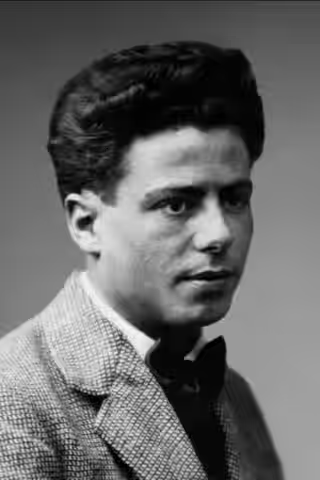
Jean Vigo was a French film director, screenwriter, editor and producer. He was born in Paris on 26 April 1905 and died in the same city on 5 October 1934.
Vigo directed, wrote, produced and edited the short feature Zero for Conduct (1933). His other completed works are the shorts À propos de Nice (1930) and Taris (1931), and the feature L'Atalante (1934).
His father was the anarchist Miguel Almereyda, who died in prison in 1917. Vigo married Lydu Lozinska and they had a daughter, Luce Vigo, who later worked as a film critic.