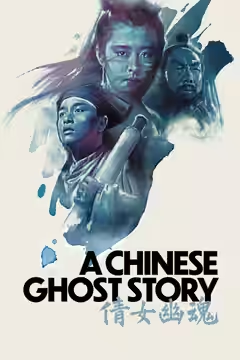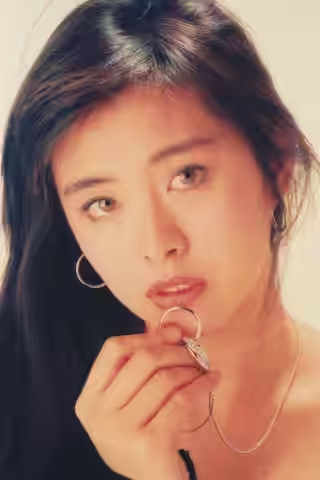
Joey Wong's gift was to stand still while everything around her flew. In A Chinese Ghost Story (1987) that stillness made a ghost the most human thing on screen; the industry then asked her to repeat it for six years, and she mostly obliged.
Fi1m perspective
Watch what Joey Wong does not do in A Chinese Ghost Story (1987). The wind machines are throwing her sleeves about, the fog sits at knee height, four cinematographers are lighting white silk from behind so that she seems made of it, and she barely moves. Leslie Cheung's frightened scholar stands in the doorway of the haunted temple; she turns from her zither, sees him, and does not smile. We did not expect to be moved by a film that drains a man to a husk in its first twenty minutes, and that one unsmiling look did it, because it told us she already knew how this would end and had chosen him anyway. Everything Tony Ching Siu-Tung throws at the screen afterwards is decoration around that look.
It was her breakthrough, and Hong Kong knew what it had. She had started in Taiwan in the mid-1980s, after modelling and basketball, and came to Hong Kong through the Shaw Brothers producer Mona Fong; after 1987 the industry cast her, over and over, as things that were not quite women: ghosts, vixens, snakes. She was Windy in A Chinese Ghost Story II (1990) and Lotus in A Chinese Ghost Story III (1991), Snow in Swordsman III: The East Is Red (1993), and the White Snake opposite Maggie Cheung in Tsui Hark's Green Snake (1993). Wong Jing put her in modern dress in God of Gamblers (1989), with Chow Yun-fat, and she played Kaori to Jackie Chan in City Hunter (1993), but the costumes kept coming back. By the mid-1990s she had slowed almost to a stop. There were brief returns in Peony Pavilion (2001) and Shanghai Story (2004), and then nothing.
The typecasting was lazy, but it was not stupid. What Wong does best is hold a frame while other people move through it, and the Hong Kong fantasy film of those years was built out of movement: Ching, an action choreographer before he directed, sends swordsmen skimming across water and tumbling through roofs, and the eye needs somewhere to rest. She was that place. The danger, in a part written as an apparition, is that stillness slides into posing, and she is at her best when a director keeps the picture busy around her and a co-star, Cheung above all, gives her someone to look at. Ching directed her three times and Cheung played opposite her three times, and that is not a coincidence.
She retired after 2004 and went to Vancouver to live quietly. Asked why, she has said: "I never quite understood why I was an actress." It is possible that what we took for poise in that temple was simply a woman who did not much want to be looked at, and that the camera read her reluctance as depth. If so, the misunderstanding served the film well, and the film still works.
Biography
Joey Wong (also credited as Joey Wang, Joey Wong Cho-Yin and Wang Tsu Hsien; Chinese: 王祖賢) is a Taiwanese actress best known for her work in Hong Kong cinema. Born on 31 January 1967 in Taipei, she began her career as a model in Taiwan before moving to Hong Kong, where her breakthrough came with the role of Lip Siu Sin in A Chinese Ghost Story (1987).
She appeared in numerous Hong Kong films through the late 1980s and 1990s, including God of Gamblers (1989), A Chinese Ghost Story II (1990), A Chinese Ghost Story III (1991), City Hunter (1993) and Green Snake (1993). Wong was regarded as one of the 'Four Flowers' of Hong Kong cinema alongside Maggie Cheung, Rosamund Kwan and Cherie Chung. She retired from acting after Shanghai Story (2004).