Jon Shenk shoots what he directs, and the shooting is the better half: he knows where to put a man beside a torrent of meltwater and how long to hold the shot. The directing, shared with Bonni Cohen, likes its subjects a little too much.
Fi1m perspective
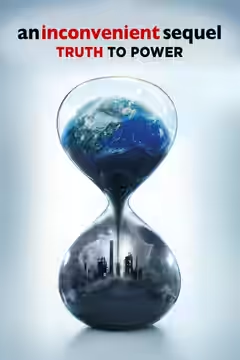
In Greenland, in An Inconvenient Sequel: Truth to Power (2017), Jon Shenk stands Al Gore beside a channel of meltwater the width of a road and lets it run. The water is grey and fast and heading for a hole in the ice, and the shot goes on long enough for the noise to make the case. That is his habit as a cameraman: find the thing, put a person next to it for scale, and do not cut. He does it again in Miami Beach, following Gore in waders down a flooded residential street on a cloudless afternoon.
He is one of the documentary makers who shoots his own films, which is rarer than it sounds and explains how close the camera gets. He trained in documentary at Stanford after reading English at Yale, and co-founded Actual Films in San Francisco with Bonni Cohen around 1999. Lost Boys of Sudan (2003) was the first feature. The Island President (2011) followed Mohamed Nasheed of the Maldives through the conferences where small countries are told to wait. Since the mid-2010s nearly everything has been made with Cohen: Audrie & Daisy (2016), the Gore film, Athlete A (2020), the short Lead Me Home (2021, with Pedro Kos), and In Waves and War and The White House Effect, both 2024. He still shoots for other directors, most recently Marlee Matlin: Not Alone Anymore (2025), where he used several cameras at once so that signed conversation would not be cut in half.
The method is observational: handheld, mobile, standing where the subject stands and staying out of the way. It depends on access, and access is what Shenk is good at, whether the subject is a president or the Paris climate conference, which gives the Gore film its one stretch of real tension. "In our minds, nothing is more dramatic than people who are up against high odds, trying to accomplish almost impossible things," he has said, and the films are built on that belief.
It is also the weakness. A camera that admires its subject that much makes a film about the subject, and An Inconvenient Sequel is a film about Al Gore before it is a film about the climate. The best witness in it is the Republican mayor of Georgetown, Texas, who moved his town to wind and solar because it was cheaper, and Shenk and Cohen treat him as a curiosity rather than the point. We gave the film a mixed notice for that reason. And yet the Greenland sequence frightened us in a way the graphs of 2006 never did, because there was nothing to interpret: that was the ice, and it was going. The pictures did the work the film kept handing to its hero.
Watch him for what he puts in front of the lens. The ice did not need anyone standing beside it, and his best shots know that.
Biography
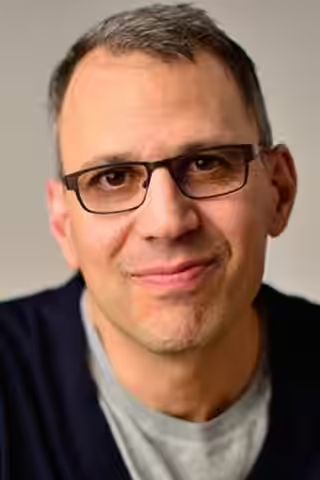
Jon Shenk is an American documentary film director and cinematographer. He co-founded Actual Films with his wife Bonni Cohen, a documentary production company based in San Francisco.
He trained in documentary filmmaking at Stanford University after earning a degree from Yale University. Shenk co-directed An Inconvenient Sequel: Truth to Power (2017) with Cohen, for which he also served as cinematographer. His other directing credits include Audrie & Daisy (2016), Athlete A (2020) and Lead Me Home (2021). Earlier work includes Lost Boys of Sudan (2003) and The Island President (2011).
Shenk has received an Emmy Award and an Academy Award nomination for his documentary work.