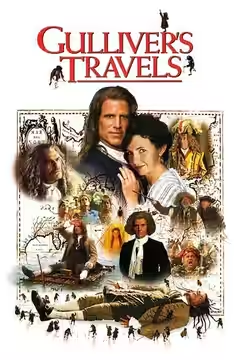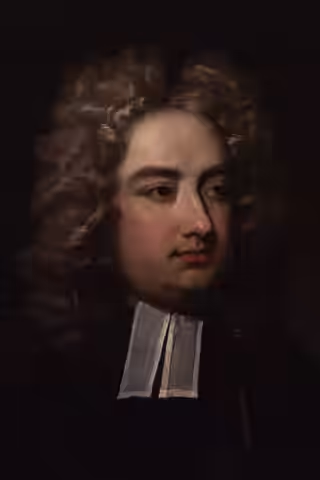
Swift wrote to vex and the screen keeps trying to divert. His satire comes out of the mouth of a narrator too plain to notice what he is saying, and the softened, abridged Gulliver most people meet has kept the giants and lost the man who invented them.
Fi1m perspective
Lemuel Gulliver's name is on the title page of the 1726 book, not Swift's. That was the habit of a lifetime. A Tale of a Tub (1704) came out anonymously, The Drapier's Letters (1724–25) under M.B. Drapier, other jokes under Isaac Bickerstaff. He preferred to speak through somebody duller than himself, a ship's surgeon or a public-spirited projector, who reports what he sees in a flat, sensible voice and never quite grasps what it means. The reader does the grasping. On screen that is a problem, because a camera cannot be unreliable the way a narrator can, and the moment you show Lilliput you have made it real and rather charming.
He had learned the trade as a political pamphleteer, writing first for the Whigs and then the Tories, editing The Examiner in 1710–11, and from 1713 he was Dean of St Patrick's in Dublin. The Irish years gave us The Drapier's Letters, which stopped a debased coinage, and A Modest Proposal (1729), which suggests the Irish poor sell their children to English landlords as food, and Gulliver between them. Writing to Alexander Pope in 1725, as he finished Gulliver, he said that "the chief end I propose to myself in all my labours is to vex the world rather than divert it". Pope, John Arbuthnot and John Gay were the friends he sharpened the jokes on.
Charles Sturridge's two-part Gulliver's Travels (1996), which we scored 73, is the clearest test we have of what survives the crossing. Simon Moore's script starts where the book never goes, at home, with Gulliver back in his village and unable to stop talking about tiny men, and it locks him in Bedlam for it. That is a good idea and the series earns most of it. Ted Danson is better than you fear and Peter O'Toole is a delight. But Moore keeps the destinations and files the point off most of them, and the last voyage ends warmer than Swift would have signed. Sturridge brings the patience of Brideshead Revisited, which suits the asylum and slows Laputa to a crawl.
We enjoyed it more than we expected to, and halfway through the second episode we caught ourselves wishing somebody on screen would be cruel. The fourth voyage is the bitterest thing in English satire, and it has long been called too misanthropic to bear, which is exactly why adaptations soften it and exactly why it is the part worth adapting. The book's long afterlife as a children's story has done the rest, so that most people now know Swift as the man with the little people and the big people and not as the man who wrote A Modest Proposal.
He told Pope he hated nations, professions and communities and loved individuals. The screen has had the pleasant version of him for a long time. If anyone wants the other one, the book is still there, and it has not got any kinder.
Biography
Jonathan Swift was an Anglo-Irish writer and clergyman. He was born in Dublin on 30 November 1667 and died there on 19 October 1745.
Swift is best known for his 1726 satirical novel Gulliver's Travels. The book has been adapted for film and television many times, including the 1996 two-part miniseries in which he is credited as the original author.