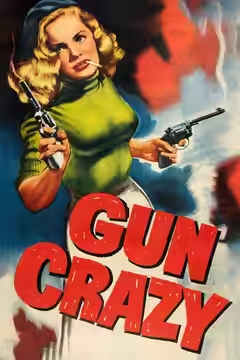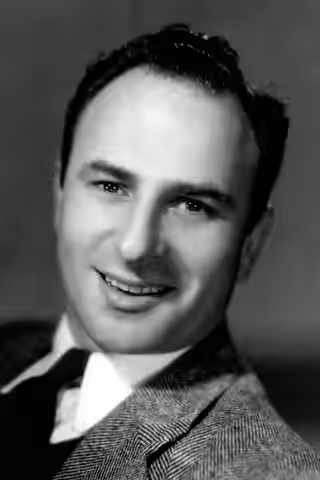
Joseph H. Lewis makes suspense out of where he puts the camera and how long he leaves it there. We rate him for keeping that ingenuity close to his actors, even when the writing explains them too simply.
Fi1m perspective
In Gun Crazy (1950), Joseph H. Lewis keeps us inside the getaway car while a robbery takes place. Russell Harlan’s camera stays there for a continuous take, denying us the change of viewpoint that a cut might provide. We felt trapped because the shot would not give us the relief of looking elsewhere. It is bold camerawork, but Lewis keeps our attention on the danger facing the couple.
His early westerns used wagon wheels and other foreground objects to enliven static or talk-heavy scenes. There is an obvious risk in that method: an attractive frame can leave the dull scene underneath untouched. The move to Columbia brought the psychological thriller My Name Is Julia Ross (1945) and more substantial material. So Dark the Night (1946) followed, taking his interest in character-driven mystery to rural France.
In Gun Crazy, Lewis gives Peggy Cummins and John Dall time to make the attraction worrying before asking the gunplay to sustain our interest. Their need for one another can hold a scene without constant action. The writing sometimes explains that dependence too simply, and we cannot accept every turn of their behaviour. Yet Lewis gives the performances enough room to make a sensible warning seem unlikely to get a hearing.
Harry Gerstad’s cutting gives the chase passages a speed quite different from the suspended wait inside the car. Lewis does not use long takes for every kind of suspense. Gordon Wiles’s production design is unobtrusive; we remember the lovers more clearly than their surroundings. Victor Young’s music adds excitement, although Cummins and Dall rarely need its help.
The Big Combo (1955), with John Alton’s low-key cinematography, offers another reason to follow Lewis beyond this film. Terror in a Texas Town (1958) returned to westerns and the wagon-wheel framing. His move chiefly into television westerns and dramas from 1958 kept him working within familiar genres. Start with Gun Crazy, preferably with someone who understands that a romance need not be reassuring.
Biography
Joseph H. Lewis (6 April 1907 – 30 August 2000) was an American film and television director. He began his career in the film industry as a camera assistant and editor before becoming a second-unit director. He directed his first feature in 1937 and went on to make numerous low-budget westerns, action pictures and thrillers over the next two decades.
Lewis is known for his work in film noir, including My Name Is Julia Ross (1945), So Dark the Night (1946), Gun Crazy (1950) and The Big Combo (1955). He also directed the musical sequences for The Jolson Story (1946). In the later part of his career he directed episodes of television western series such as The Rifleman, Bonanza, The Big Valley and Gunsmoke (1955). He received the Los Angeles Film Critics Association Lifetime Achievement Award in 1997.