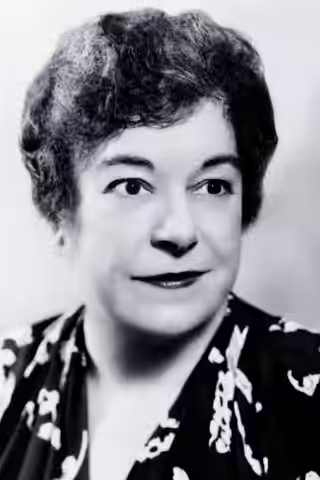
A stage comedian who came to film late and seldom, Josephine Hull played sweet, muddled older women whose sweetness was never a joke on them. Two screen parts, both from Broadway, show why nothing she did was pushed.
Fi1m perspective
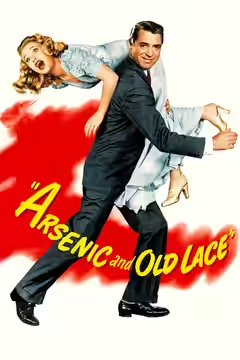
In Arsenic and Old Lace (1944), Mortimer Brewster lifts the lid of the window seat, finds a dead man, and turns to his aunt. Josephine Hull's Abby does not deny it. She explains it, with the patience of a woman describing a jumble sale, and when he asks what they used she gives him the recipe. That is Hull's method in a single scene. What the character says is monstrous; the woman saying it is serene, and she never lets us see that she knows the difference.
She was a stage actor first and very nearly only. Hull made her debut in Boston stock in 1905, worked as a chorus girl and touring player, and by the 1920s was on Broadway in George Kelly's plays and directing productions of her own. Then came three long runs in a row: Penelope Sycamore in You Can't Take It with You (1936), Abby Brewster in Arsenic and Old Lace from 1941, and Veta Louise Simmons in Harvey from 1944. Two of those parts went to film, in 1944 under Frank Capra and in 1950 under Henry Koster, and they are most of her screen work. A handful of films is a thin record. It is also why the ones that exist are so finished: by the time a camera saw her she had said the lines every night for years.
Capra's Arsenic is a noisy film. Cary Grant works far too hard and the farce goes round its loop once too often. Hull and Jean Adair, who played her sister Martha on stage and on screen, are the reason it works, because neither of them is in on the joke. We laughed out loud and then caught ourselves, since she had not asked us to laugh; she had simply told a nephew what was in the wine. Whenever the film threatens pantomime one of the aunts pours a glass and it steadies. In Harvey (1950), opposite James Stewart, the reviews of the time noticed what we noticed in 1944: her timing, her physical comedy, and the lightness she gives a flustered woman.
The limit was the material, not her. Later plays such as The Golden State (1950) and Whistler's Grandmother (1952) were short-lived, and reviewers said the writing did not match the performance; it took Kaufman and Teichmann writing The Solid Gold Cadillac (1953) around her to give her a part worth the run. She did not mind the camera coming late. "I'm very happy that I'm frankly a character woman, when I see what the camera does to so many faces on the screen." Film got her twice, both times after years of rehearsal, and both times it shows. That is the kindest thing a film can do for an actor, and the rarest.
Biography
Josephine Hull (née Sherwood) was an American stage and film actress. She made her stage debut in stock in 1905 after attending Radcliffe College and performed under her birth name before adopting her married name following her 1910 marriage to actor Shelley Hull. Widowed in 1919, she resumed her career in the 1920s and became known for comic roles on Broadway, including in You Can't Take It With You (1936), Arsenic and Old Lace (1941) and Harvey (1944).
Hull recreated several stage roles on screen. She played Aunt Abby Brewster in the 1944 film Arsenic and Old Lace and Veta Louise Simmons in the 1950 film Harvey, for which she won the Academy Award for Best Supporting Actress. Her other film credits include After Tomorrow (1932), Careless Lady (1932) and The Lady from Texas (1951). She died in 1957.