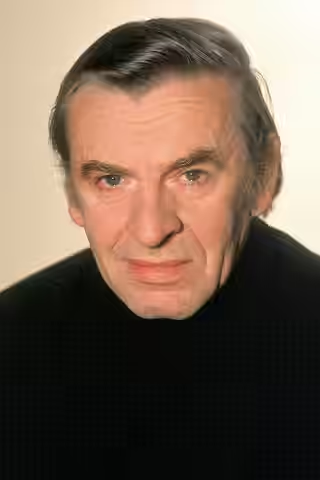
Jozef Kroner played men who lose the argument before it starts: shuffling, agreeable, decent up to the point where decency costs something. In The Shop on Main Street that man is hard to forget, and a long career afterwards mostly kept him in gentler company.
Fi1m perspective
The picture we keep of Jozef Kroner is a man sitting in a shop that is not his, cap in his hands, while a deaf old woman brings him soup. He has come to explain the law to her. He leaves having been fed. In The Shop on Main Street (1965) Kroner plays Tono Brtko, a carpenter who has never won an argument, and he plays him in the body first: the shuffle, the scratch, the yes that means no, the protest that lasts as long as it takes to pour a drink. We went in braced for a film about the Holocaust and spent the first hour laughing at him, gently, the way you laugh at an uncle, and when the laughing stopped we did not notice at first. He never asks for our sympathy. He never quite loses it either.
He arrived at that part without a day of formal training. He came up through amateur theatre groups in Slovakia, turned professional around 1948 at the Slovak Chamber Theatre in Martin, and joined the Slovak National Theatre in Bratislava in 1956. His film work began modestly in 1949. It was Ján Kadár and Elmar Klos who put him in front of the world in 1965, and three years later he was Franz in Alain Robbe-Grillet's The Man Who Lies (1968), an experimental French-Czechoslovak co-production about truth and memory, about as far from a small-town shop as an actor can travel.
After 1968 the demanding parts thinned out. The normalisation years gave him lighter work, a good deal of it on television, and the folk types he had always been able to play became most of what he was asked to play. There were exceptions. He was Pacho Matrtaj in Pacho, hybský zbojník (1975), a popular comedy with some social comment under the adventure, and Martin Pichanda, the patriarch, in Juraj Jakubisko's The Millennial Bee (1983). He worked twice with the director Martin Ťapák. He left the stage in the mid-1980s and was still filming in 1992, as Košťál in the Czech comedy Dedičstvo alebo Kurvahošigutntag. We have not reviewed those films and will not judge them here.
What he did that other actors do not is take the joke and the shame in the same breath. Directors and critics noticed the voice, and it is a fine instrument, but the real thing is that he could make a coward funny without letting us off. Ida Kamińska is the reason The Shop on Main Street works, as we said in our review, and Kroner's part in that is to give her something to work against: a man who is present, kind and useless. It is harder acting than it looks, because there is nowhere in it to hide.
If you know him only from the one film, that is not a bad way to know him. Start there. The later comedies are for people who already like him and want the same man in easier parts.
Biography
Jozef Kroner (1924–1998) was a Slovak actor. He appeared in more than fifty Slovak films and several Czech, Bulgarian and Hungarian productions. His best-known role was as the carpenter Antonín 'Tóno' Brtko in the Oscar-winning film The Shop on Main Street (1965).
Kroner began his career in amateur theatre groups without formal training and later joined professional companies, including the Slovak Chamber Theatre in Martin and, from 1956 to 1984, the drama ensemble of the Slovak National Theatre in Bratislava. He also wrote several autobiographical books and was the subject of a 1987 documentary biography.
His wife Terézia Hurbanová-Kronerová, brother Ľudovít Kroner and daughter Zuzana Kronerová were all actors. Awards in his name have been presented annually since 2001 by the Jozef Kroner Foundation.