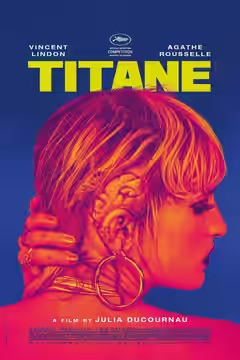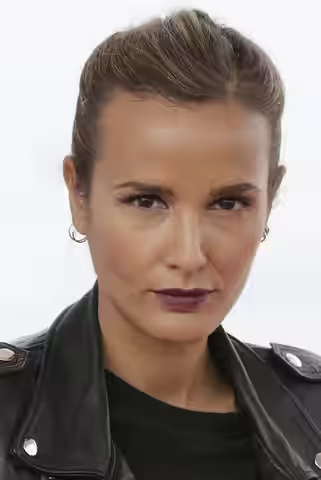
Julia Ducournau makes films in which something goes wrong with a body: a girl who eats flesh, a woman who bleeds oil. Raw was tight and funny; Titane is bigger, stranger and less sure what it means. We rate her, with reservations about the middle.
Fi1m perspective
The image we kept from Titane (2021) is oil where blood should be. Alexia, played by Agathe Rousselle, has a titanium plate in her head from a childhood crash and gets pregnant by a car, and as the pregnancy grows her skin splits to show metal underneath. Ducournau shoots it close and does not look away. That is her habit in one sentence: a body does something it should not, the camera stays on it, and we are asked to keep watching until the flinch passes and we start to wonder what the person inside is feeling. She once said of the girls in Raw, "A body is a body." She films as if she means it.
She trained in screenwriting at La Fémis in Paris, made a short, Junior (2011), and a co-directed television film, Mange (2012), and then Raw (2016), about a vegetarian who develops a taste for flesh. We found Raw tight, funny and controlled. Garance Marillier, who led it, turns up in Titane as a fellow dancer, a nod admirers of the first film will enjoy. Titane itself was looser, bigger and less certain, and we scored it 74. Since then she has directed episodes of Servant (2021) and The New Look (2024), and a third feature, Alpha (2025), which the reviews so far have called dour and disjointed. We have not reviewed it and will not pretend to judge it here.
What works is the pairing of extremity with tenderness. The best of Titane is not the killing or the car but Vincent Lindon's fire captain, a lonely man who takes in a stranger and decides she is his missing son, so that the second half becomes a story about two damaged people agreeing to believe a lie. We watched the pregnancy scenes with a dread we could not put a name to, and that is both the praise and the complaint: the make-up is a marvel, and we never knew what Ducournau wanted the thing to mean. Motherhood, gender, the body as a machine that will not take orders: the film touches each and settles on none.
What does not work is patience. Once Alexia is inside the fire station the story has two questions, will she be found out and what is she carrying, and Ducournau lets both idle for forty minutes. A young fireman, Rayane (Laïs Salameh), suspects her, and the thread is picked up and dropped. Cronenberg's Crash is the plain ancestor for the car and she does not hide it; his people were bored and hers are desperate, which is the more interesting condition and the harder one to sustain.
Two features in, the method is sound and the subjects keep changing. Raw knew what its horror was for. Titane half knew. Start with the first, bring a strong stomach to the second, and see whether the third knows what it is about.
Biography
Julia Ducournau is a French film director and screenwriter. She studied screenwriting at La Fémis in Paris. Her short film Junior (2011) won the Petit Rail d'Or at the Cannes Film Festival.
Her first feature, Raw (2016), premiered in the Critics' Week section at Cannes. She wrote and directed Titane (2021), which won the Palme d'Or at the 2021 Cannes Film Festival, making her the second female director to receive the award and the first to win it solo. She has also directed episodes of the television series Servant (2019) and The New Look (2024). Her third feature, Alpha (2025), premiered at Cannes.