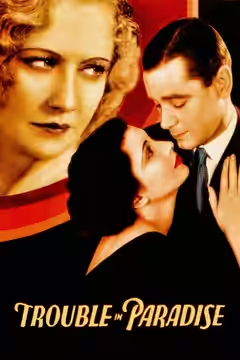
Kay Francis could make a worldly woman seem capable of being hurt without surrendering her poise. We value the warmth and unforced wit beneath the celebrated wardrobe, most clearly in Trouble in Paradise.
Fi1m perspective
In Trouble in Paradise (1932), Kay Francis does not advertise a joke before delivering it. As Mariette, a wealthy perfume-company owner targeted by thieves, she has the composure to belong in this polished company. We were touched by Mariette’s warmth; Francis makes the possibility of hurt credible without interrupting the comedy to ask for sympathy. The film’s polished manners occasionally make that prospect seem too remote, but she gives us a reason to care when deception might otherwise be enough to sustain the comedy.
Her early screen work included The Cocoanuts (1929), but the films of 1932 give a clearer idea of what she could do. She moved from Paramount to Warner Bros. that year and was loaned back for Ernst Lubitsch’s Trouble in Paradise. William Powell, a frequent partner, appeared with her in the shipboard romance One Way Passage (1932) and the caper comedy Jewel Robbery (1932). Those films put her poise to different uses: suffering in one, adventurous wit in the other. The House on 56th Street (1933) points towards the fashion-conscious melodramas that occupied much of her starring period.
The clothes matter, and costume designers Travis Banton at Paramount and Orry-Kelly at Warner Bros. helped shape her screen appearance. Some notices paid more attention to the wardrobe than the acting. Yet in Trouble in Paradise, which Banton dressed, the pleasure lies in how little she presses. Herbert Marshall gives Gaston a calm that Miriam Hopkins’s impatient Lily usefully disturbs; Francis adds warmth without demanding a pause in the comedy to establish it. The three performers allow small shifts of emphasis to register, and none needs to insist that we have noticed.
The later 1930s brought fewer major productions, followed by freelance work and B-pictures with often weaker material. In Name Only (1939), with Cary Grant and Carole Lombard, remains a notable supporting role from that change of fortunes. She went on to co-produce three Monogram films in 1945–46. Start with Trouble in Paradise; for more of her wit, follow it with Jewel Robbery.
Biography
Kay Francis was an American stage and film actress, also credited as Katherine Edwina Gibbs and Katherine Francis. Born in Oklahoma City, she began her career with Broadway appearances in the late 1920s, including a modernised Hamlet and Elmer the Great (1928).
She moved to film under contract with Paramount and achieved her greatest success between 1930 and 1936 as the leading female star at Warner Brothers and the highest-paid American film actress of the period. Her notable roles include The Cocoanuts (1929), Trouble in Paradise (1932) as Mariette, One Way Passage (1932), Jewel Robbery (1932) and In Name Only (1939).
Francis appeared in further films through the 1940s, later co-producing and starring in low-budget productions for Monogram before returning to stage work.