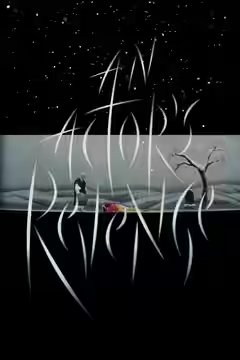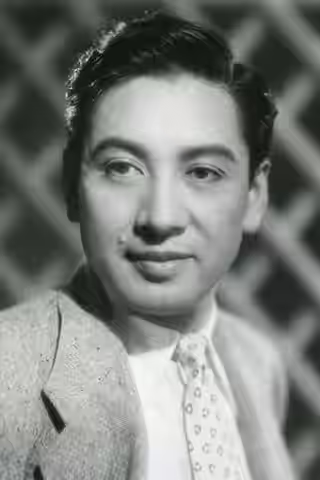
Trained in kabuki as a boy and a film star for thirty-six years, Kazuo Hasegawa specialised in men holding a performance in place, and he let us watch the effort. At his best, in An Actor's Revenge, both halves share one frame.
Fi1m perspective
Watch how Yukinojo walks. In An Actor's Revenge (1963) Kazuo Hasegawa keeps the onnagata's steps small and the voice high and level whether he is on stage or in the street. You can see the performance being held in place by will, which is the point: he has made himself into a woman for the theatre and kept it up off stage, in the service of a grievance. In the same film he is also Yamitaro, a thief who sits above the story and heckles it, loud and broad and pleased with himself. He does both well, and neither leaks into the other.
Hasegawa first played Yukinojo and the thief in Teinosuke Kinugasa's 1935 version, when he was still Chōjirō Hayashi, the name under which he made more than 120 films for Shochiku in eleven years from 1927, many for Kinugasa. He had been on the kabuki stage since he was five and trained as an onnagata from 1918, which is where the walk and the voice come from. He moved to Toho in 1937 and took back his own name, joined Daiei around 1950, and stayed until he retired from films after his three-hundredth role, the 1963 An Actor's Revenge.
Audiences outside Japan met him in the Daiei years, and the pattern is consistent. In Kinugasa's Gate of Hell (1953) he is Morito, a samurai whose composure covers an obsession; in Kenji Mizoguchi's Chikamatsu Monogatari (1954) he is Mohei, a principled apprentice caught in a forbidden love and punished for it. The samurai bearing, the graceful swordwork, the dignity: all kabuki, all serving men whose insides do not match their outsides. Between the literary pictures he played the detective Zenigata Heiji through a long popular series, the lighter side of the same authority.
The 1963 film moved us more than a revenge melodrama staged on painted flats has any business doing, and it was Hasegawa who did it: the way Yukinojo comes off stage and does not drop the voice, so that you begin to wonder whether he has anywhere left to put it down. He was fifty-five, playing a part written for someone far younger, and the years show; some have found that a distraction. We did not. An onnagata is already pretending, and an older one is pretending harder, and Kon Ichikawa's film is about nothing else.
At home his reputation rests on three hundred films and thirty-six years of being the man people paid to see; abroad, on a handful from the 1950s and 60s, which is thin for a career that size and not his fault. Start with An Actor's Revenge, where Ichikawa gives him a whole theatre to be two people in. Then go looking for Kinugasa, who directed him from the Shochiku days to Gate of Hell and knew what he was for.
Biography
Kazuo Hasegawa was a Japanese film and stage actor. Born on 27 February 1908 in Kyoto, he began performing on stage as a child and trained in kabuki theatre. He made his film debut in 1927 under the name Chōjirō Hayashi with the Shochiku studio, where he became a leading star of jidaigeki films, appearing in more than 120 productions over the next decade.
Hasegawa moved to Toho in 1937 and later adopted his real name following an attack on his face. He joined Daiei Film in 1950 and continued to appear in popular series and acclaimed films. He is known for roles in Gate of Hell (1953), Chikamatsu Monogatari (1954) and An Actor's Revenge (1963), the latter marking his 300th film appearance, in which he played both Yukinojo Nakamura and Yamitaro the Thief. Hasegawa died on 6 April 1984 in Tokyo.