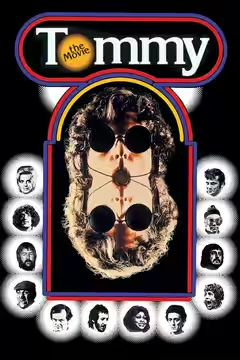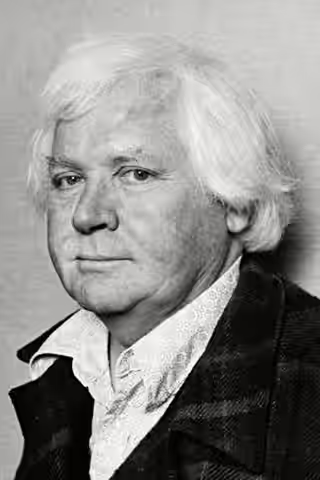
Ken Russell turns music into extravagant screen fantasy, with performances pitched to match. We admire the invention and recommend Tommy with reservations: his determination to make every number count can leave little room for the drama.
Fi1m perspective
In Tommy (1975), a musical number rarely arrives without demanding our full attention. Russell treats Pete Townshend’s songs as permission for theatrical extravagance, and the performances help justify the noise. It is a good, uneven film, worth an evening for anyone with a taste for excess. His enthusiasm is part of the appeal, although he does not always seem to notice when a number has made its point.
That interest in putting music on screen was already central to his BBC work, including the composer profiles Elgar (1962) and Song of Summer (1968). The move into features brought a breakthrough with Women in Love (1969), followed by composer films such as The Music Lovers (1971) and Mahler (1974). He approaches the composers through fantasy, dreams and psychological distress rather than a dutiful account of the life. Music gives him a way of showing what people cannot comfortably explain about themselves.
In Tommy, Townshend’s music supplies a firmer shape than Russell’s screenplay, which struggles to connect one emphatic number to the next. Editor Stuart Baird makes the individual numbers register, but the joins remain less convincing. Russell is persuasive when a song can carry all that extravagance; he is less reliable when the story needs a pause. We grew tired during Tommy because the insistent sound and repeated high points left too little time for anything to settle.
It would be a mistake to reduce him to noise: his taste for physically expressive acting matters just as much as the dream sequences. His repeated work with Oliver Reed and Glenda Jackson belongs to a cinema that asks performers to accept its heightened emotions without embarrassment. His later Hollywood work included the science-fiction horror Altered States (1980), continuing his interest in putting inner experience on screen. Start with Tommy if rock music and theatrical excess appeal; anyone hoping for a quiet introduction should choose another director.
Biography
Ken Russell (3 July 1927 – 27 November 2011) was an English film director, screenwriter and producer. Born in Southampton, he served in the Merchant Navy and the RAF before working as an actor, dancer and photographer. In the late 1950s he joined the BBC, where he directed arts documentaries for the Monitor programme, including dramatised biographies of composers.
Russell’s feature films include Women in Love (1969), The Devils (1971), on which he also wrote the screenplay and served as producer, and Tommy (1975), for which he was likewise credited as director, screenwriter and producer. Other works include Altered States (1980), Gothic (1987) and The Lair of the White Worm (1988). His films often drew on literary or musical sources and attracted controversy.