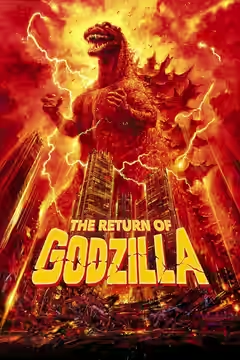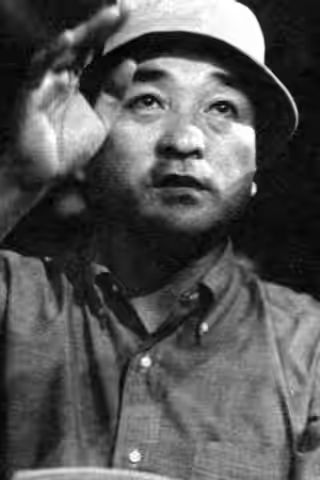
Koji Hashimoto spent twenty years as Ishirō Honda's assistant and directed two films of his own, both in 1984. The Return of Godzilla is the one that matters: grave, handsome and stiff, a good idea that never quite becomes a good evening.
Fi1m perspective
A torch beam moves through a dead trawler and the camera declines to hurry. That is the whole of Koji Hashimoto's manner as a director, and it is all in the first minutes of The Return of Godzilla (1984), the film on which his reputation rests. Kazutami Hara shoots the boat in wet greens and near-black, Yoshitami Kuroiwa lets the cuts sit, and when Goro Maki (Ken Tanaka) goes below deck what he finds is not the monster but the shrivelled faces of its crew. We were more unsettled than we had bargained for from a PG film about a man in a rubber suit; a dead sailor lit from beneath stayed with us longer than any of the later explosions.
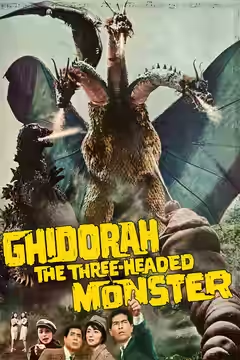
He came to that opening late. Hashimoto spent more than twenty years at Toho as an assistant director, on more than seventy productions, most of them other people's monsters: King Kong vs. Godzilla (1962), Ghidorah, the Three-Headed Monster (1964) and Invasion of Astro-Monster (1965), all under Ishirō Honda, with a detour to Akira Kurosawa's Dodes'ka-den (1970). He directed two features, both in 1984. Bye-Bye Jupiter, co-directed with Sakyo Komatsu, was his debut, and most of the reviews found it overlong and scattered. The Return of Godzilla followed the same year, and after it he went back behind the scenes, producing for Toho until his death in 2005.
So there is one film to judge, and it is half a good one. The good half is the seriousness. Hashimoto ignored every sequel after 1954 and treated the monster as a Cold War problem for a nervous Cabinet: no wrestling, no children, no tune you could hum, 103 minutes without a smile. Teruyoshi Nakano's effects give him a handsome Godzilla, and Hashimoto said of the film, "I wanted viewers to feel sorry for Godzilla, and I think I succeeded." In the wide shots he sometimes does.
The weak half is everybody standing on two legs. The meetings are better than the love story, the people are stiff, and the human scenes have the feel of a man who watched Honda stage them seventy times and learned where to put the actors but not how to make us mind about them. The pace slackens whenever the film leaves the Cabinet room, and it leaves it too often.
That is an assistant's career, and Hashimoto seems to have accepted it: two features, then the producer's chair. See The Return of Godzilla for its first reel and its committee rooms, and go in knowing it cares more about what the ministers decide than about whom Maki loves. It is not a good evening, but it is a serious one, and in this series that was rarer than it should have been.
Biography
Koji Hashimoto (also credited as Hashimoto Kōji or Kohji Hashimoto) was a Japanese film director and producer. He began his career as an assistant director at Toho in the early 1960s, working on numerous kaiju and tokusatsu films.
Hashimoto made his directorial debut in 1984 with Sayonara Jupiter (also known as Bye-Bye Jupiter) and The Return of Godzilla. He later worked as a producer on several 1990s Toho productions, including Godzilla vs. Mothra (1992), Godzilla vs. Destoroyah (1995) and the Rebirth of Mothra trilogy (1996–1998).
Born on 21 January 1936 in Ashikaga, Tochigi, Japan, Hashimoto died on 9 January 2005 in the same city.