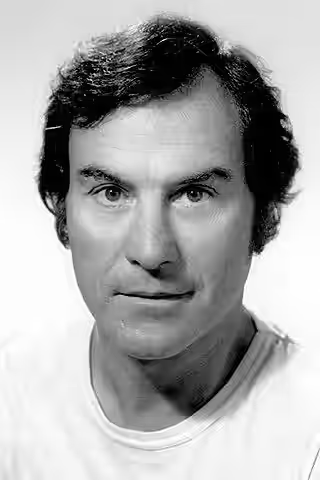
Leonardo Villar played steadfast men, most of them poor and devout, and made their conviction look like something they had no say in. Outside Brazil his screen career rests on one 1962 lead, and it can bear the weight.
Fi1m perspective
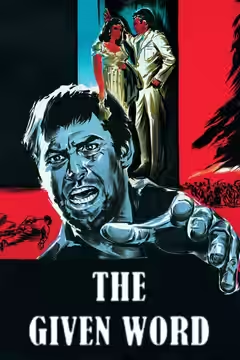
Zé do Burro explains his promise to a priest, then to a reporter, then to a crowd, and he uses the same flat words each time. He barely raises his voice. In The Given Word (1962) Leonardo Villar plays a farmer who does not know he is being stubborn, because to him there is nothing to decide: he said he would carry the cross to the church, so he is carrying it. Most actors handed a saint or a simpleton let us see the effort of holding the pose. Villar does not, and that is the whole trick.
He came to the cinema at 38 and already formed. Trained at the Escola de Arte Dramática in São Paulo, in its first graduating class of 1948, he spent eight years with the Teatro Brasileiro de Comédia doing Arthur Miller and Nelson Rodrigues, and his Eddie Carbone in A View from the Bridge (1958) was the part that made his name on stage. The Given Word was his first film. Two more leads followed quickly, both title roles in dramas of the Brazilian interior: Lampião, o Rei do Cangaço (1964) and A Hora e a Vez de Augusto Matraga (1965). Then, from 1965, television, and more than thirty telenovelas over the next four and a half decades, often as fathers, priests and men in charge. He went back to the theatre in 2001.
What critics kept noticing, on stage and on screen, was a truthfulness with no sentiment in it, and we saw the same thing. Anselmo Duarte's staging in The Given Word is plain and its villains are drawn thick, and it is Villar's patience that keeps the film upright while the square fills around him. When he finally sits down on the church step and lays the cross across his knees, we were moved more than we expected to be by a man sitting down. It works because he has spent an hour refusing to ask for our sympathy; the face has been held so still that one small sag in the shoulders reads as a collapse. Dionísio Azevedo, opposite him, plays the priest as frightened rather than wicked, and the two men give the film its one real argument.
The complaints about that film, when they came, were about the production and its place in the Brazilian cinema of the time, not about him. The honest caveat is ours: we have reviewed one of his films, and the bulk of his later work is television made for a Brazilian audience that we have not seen, including a much-noted turn as a religious fanatic, Ezequiel Ribeiro, in Barriga de Aluguel (1990). He described himself as "calmo, tranquilo, tímido, muito fechado", a calm, shy, closed man who said on stage what he could not say in life, and the account squares with the actor on the steps.
For most viewers outside Brazil, then, the career is in practice a single film, and the recommendation is simple. Watch The Given Word for the man with the cross, and notice how little he does.
Biography
Leonardo Villar (born Leonildo Motta) was a Brazilian actor. He was born on 25 July 1923 in Piracicaba, São Paulo, and died on 3 July 2020 in São Paulo.
He began his career in the theatre in the 1950s and trained at the Escola de Arte Dramática of the University of São Paulo. Villar first played the role of Zé do Burro in the 1960 stage production of Dias Gomes's play O Pagador de Promessas. He reprised the part in Anselmo Duarte's 1962 film adaptation The Given Word, which won the Palme d'Or at Cannes and became the first Brazilian film nominated for the Academy Award for Best Foreign Language Film.
Villar appeared in numerous films, including Lampião, King of the Badlands (1964) and The Hour and Turn of Augusto Matraga (1965), and worked extensively in Brazilian television, notably for Rede Globo.