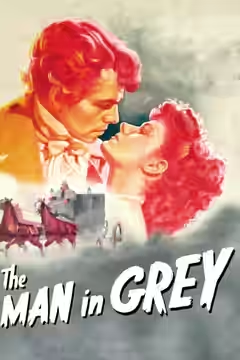
Leslie Arliss’s costume melodramas make room for women who want to live on their own terms. We enjoy their bad behaviour, but The Man in Grey reveals how much his slack pacing asks of good actors.
Fi1m perspective
In The Man in Grey (1943), Margaret Lockwood and James Mason make bad behaviour worth watching even when the film takes too long to reach it. Arliss understands the appeal of people who want things they ought not to want, particularly women hemmed in by class and convention. We rate him cautiously: his costume melodramas offer strong parts, but his direction can seem content to wait for an actor to make something happen. At 116 minutes, The Man in Grey asks rather more patience than that arrangement deserves.
His move from screenwriting to directing began with the co-directed The Farmer’s Wife (1941), followed by his first solo film, The Night Has Eyes (1942), with Mason. The important stretch is the Gainsborough work: The Man in Grey, Love Story (1944) and The Wicked Lady (1945). Love Story moved the emphasis on desire and emotional excess into a contemporary setting. The Wicked Lady gave Lockwood a defiant highwaywoman to play. Across the costume melodramas, women choosing for themselves, betrayals and differences of class supply plenty of trouble.
The difficulty is giving that trouble enough urgency. In The Man in Grey, the screenplay by Margaret Kennedy and Arliss keeps extending matters after their interest is clear, while R.E. Dearing’s editing allows the material more room than it needs. We grew impatient because the film made us wait for pleasures Lockwood and Mason had already shown they could deliver. The visual character of Arliss’s melodramas also owes much to cinematographer Arthur Crabtree and costume designer Elizabeth Haffenden, rather than to any particular distinction in his direction.
What the writing does better is let its heroines say plainly what they want, sometimes in sharply direct one-liners. That interest makes Arliss worth considering without pretending the direction is more alert than it is. After Gainsborough, his standing declined with films such as Idol of Paris (1948); B-pictures and television followed in the 1950s. Begin with The Man in Grey if costume melodrama is already a pleasure; Lockwood and Mason are better reasons to stay than any expectation of brisk storytelling.
Biography
Leslie Arliss was a British screenwriter and director. Born Leslie Andrews in London on 6 October 1901, he began his career as a journalist in South Africa before returning to London in the late 1920s and entering the film industry as a scenario writer.
He worked extensively as a screenwriter in the 1930s, including on comedies and the historical film Rhodes of Africa (1936). Arliss became scenario editor at Gainsborough Pictures and made his directorial debut with a 1941 remake of The Farmer's Wife. He achieved his greatest success with the Gainsborough melodramas The Man in Grey (1943), which he directed and co-wrote, Love Story (1944) and The Wicked Lady (1945). He later directed for British Lion Films and worked in television. Arliss died on 30 December 1987 in Jersey, Channel Islands.