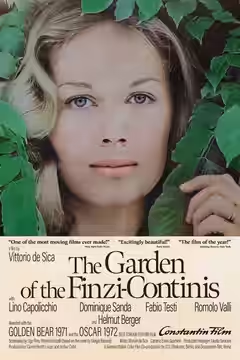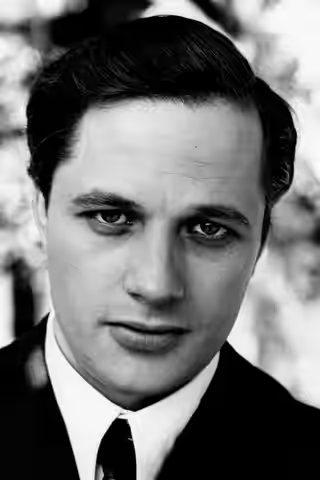
Lino Capolicchio is persuasive as the quiet man trying to understand the company he keeps. We value the way he makes restrained drama approachable, though his understatement cannot always compensate for what a screenplay leaves unexplained.
Fi1m perspective
In The Garden of the Finzi-Continis (1970), Lino Capolicchio gives us someone to follow while the people around him remain difficult to read. His Giorgio is more immediately approachable than Dominique Sanda’s Micól, whose composure can attract and frustrate within the same scene. He suits Vittorio De Sica’s restraint without making us work quite so hard to care. The film’s people mistake social standing for safety, and his approachability lets us stay with them without having to share their confidence. We were moved by his performance because that difference gives us a way into a company whose remoteness might otherwise keep us outside.
Leading parts in Roberto Faenza’s Escalation (1968) and Giuseppe Patroni Griffi’s Metti, una sera a cena (1969) preceded the wider recognition that came with Giorgio. He was repeatedly cast as an introspective outsider, a part well suited to his quiet observation. His work moved between period drama, thrillers and lighter television roles, so the restraint should not be mistaken for a commitment to one sort of story.
There is a cost to that quietness, and The Garden of the Finzi-Continis shows it. The acting, including Helmut Berger’s Alberto, suits De Sica’s restrained telling. Yet it is sometimes difficult to tell what these people are concealing and what the screenplay has left unwritten. Capolicchio gives us a more immediate connection, but he cannot explain why the characters seem unable to act when the writing itself is uncertain. We would not want him to solve that problem by pushing harder: his restraint is part of what makes the company convincing in the first place.
Pupi Avati found another use for his watchfulness in The House with Laughing Windows (1976), casting him as Stefano, a restorer working on a sinister fresco. The ordinary man trying to understand an unsettling place gave that quiet style a clear job to do. It began a long collaboration which also included Capolicchio’s Leopold Mozart in Noi tre (1984). Avati’s atmosphere can make the actor secondary, and Capolicchio’s understatement does not always resist it. Begin with The Garden of the Finzi-Continis; go on to Avati if a patient investigator is your preferred company for a thriller.
Biography
Lino Capolicchio (1943–2022) was an Italian actor, screenwriter and director. He trained at the Accademia Nazionale d'Arte Drammatica in Rome after growing up in Turin, and began his career with an uncredited role in Franco Zeffirelli's The Taming of the Shrew (1967). He appeared in more than seventy films and television dramas.
Capolicchio is best known for playing Giorgio in Vittorio De Sica's The Garden of the Finzi-Continis (1970), a role that earned him a David di Donatello award. Other notable film credits include The House with Laughing Windows (1976), The Bloodstained Shadow (1978) and Lion of the Desert (1981). He also wrote and directed the 1995 film Pugili and provided the Italian voice for Bo Duke in The Dukes of Hazzard.