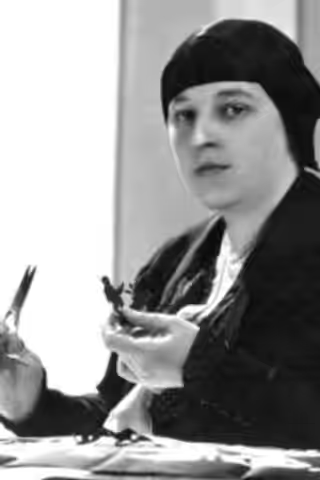
Lotte Reiniger’s silhouette figures move with a delicacy that earns our affection. We warmly recommend her animation, with one reservation: in The Adventures of Prince Achmed, the adventure and romance are less involving than the images.
Fi1m perspective
Reiniger gives us a silhouette and asks us to read its feelings through movement and outline. In The Adventures of Prince Achmed (1926), the figures are expressive enough to make its fantasy inviting. We were charmed by the life she gives them. They earn our affection without requiring any special allowance for the age of the film.
Cinderella (Aschenputtel) (1922) already had the fairy-tale subject and silhouette technique that would recur throughout her work. The Adventures of Prince Achmed took three years and a small team, but the feature can obscure how much of her career was spent on shorter forms. She went on to concentrate on shorts and sequences within other films. Papageno (1935), drawn from scenes in Mozart’s The Magic Flute, continues her interest in matching movement to music. Fairy-tale adaptations for television followed in the 1950s, and she kept making films into the late 1970s.
Her figures were articulated cut-outs of black cardboard and lead, joined with wire hinges and photographed frame by frame on a backlit glass table. Layered glass planes gave The Adventures of Prince Achmed depth, allowing its flat figures to move through a convincing space. Carl Koch worked with her as producer and camera operator, while Walther Ruttmann and Berthold Bartosch assisted with the feature’s backgrounds and animation. Wolfgang Zeller supplied the music. The result rewards close attention to movement, though we never need to understand the equipment to enjoy it.
The reservation is about the screenplay, which on The Adventures of Prince Achmed was also Reiniger’s. The adventure holds our interest without making us particularly anxious, and the romance leaves too much of the emotional work to the animation. At 66 minutes, it can still feel slight. We occasionally wanted more than another opportunity to admire the images, but that is a criticism of this story, not a verdict against the technique. Give The Adventures of Prince Achmed an evening, but do not expect its romance to be what stays with you.
Biography
Lotte Reiniger, also credited as Charlotte Reiniger, was a German director and pioneer of silhouette animation. She directed and wrote the screenplay for The Adventures of Prince Achmed (1926), recognised as the oldest surviving animated feature film.
Born in Berlin in 1899, Reiniger entered the film industry in the late 1910s through work with Paul Wegener. She married Carl Koch in 1921; he collaborated on her films as cinematographer and producer. She made numerous short silhouette films over a career lasting until 1980. Reiniger died in Dettenhausen in 1981.