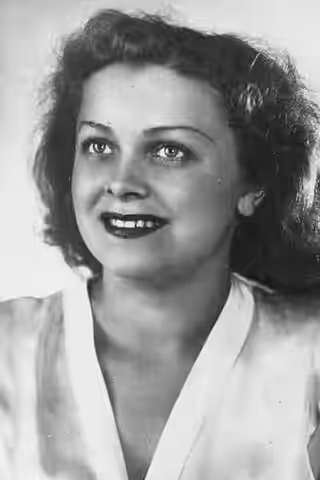
Lyudmila Tselikovskaya makes cheerfulness persuasive, a harder task than it looks. We value her lively comic manner and the poise she brings to Ivan the Terrible, Part I, though Eisenstein’s formality can keep us at a distance.
Fi1m perspective
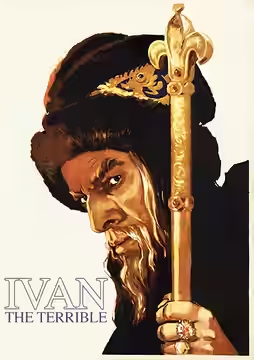
Tselikovskaya’s Anastasia is poised and restrained in Sergei Eisenstein’s Ivan the Terrible, Part I (1944). The liveliness associated with her comic roles gives way to a more formal manner, and she handles the change with assurance. We recommend the film for its forceful images, though it is an incomplete introduction to an actor whose appeal so often depended on warmth. Her ability to adapt is clear; the qualities that made her a popular comic performer are less apparent.
Nikolay Cherkasov’s severe performance is the more immediately arresting presence. We were gripped by the film because his severity and the force of Eisenstein’s images make its formal style compelling, even when the people remain remote. Tselikovskaya works comfortably within that style, but Anastasia offers limited scope for the everyday vitality associated with her lighter parts. The reservation concerns what the film allows us to see of her, not her ability to meet its demands.
Her reputation had developed through films such as Anton Ivanovich Is Angry (1941) and The Aerial Cabman (1943), whose script was written specifically for her. An expressive face and a lively manner suited the optimistic young women she frequently played. Konstantin Yudin’s Hearts of the Four (1945) and Twins (1945) gave her further comic roles. What interests us about that work is the warmth: cheerfulness need not make a character dull, and her animation gives us something to watch.
The historical part did not lead to a steady succession of substantial screen opportunities. Her film roles declined sharply after the war, with Samson Samsonov’s Chekhov adaptation The Grasshopper (1955) providing a notable later dramatic part as Olga Ivanovna Dymova. It belongs in an account of her work, but there is no reason to treat the move into drama as evidence that she had outgrown comedy. The earlier films deserve attention on their own terms.
Begin with Ivan the Terrible, Part I if its deliberate formality appeals. Eisenstein and Cherkasov provide the chief reasons for our recommendation, while Tselikovskaya’s composure makes a quieter impression. Then try Hearts of the Four before deciding that solemn historical drama tells us all we need to know about her.
Biography
Lyudmila Vasilyevna Tselikovskaya (also credited as L. Tselikovskaya) was a Russian actress who appeared in films and on stage. She was born on 8 September 1919 in Astrakhan and died on 4 July 1992 in Moscow.
Tselikovskaya trained at the Shchukin Theatrical School attached to the Vakhtangov Theatre in Moscow, graduating in 1941, and remained a member of the Vakhtangov troupe until her death. She is known for film roles including Sima Voronova in Anton Ivanovich Gets Angry (1941), Natasha Kulikova in The Aerial Cabman (1943), Tsarina Anastasia Romanovna in Sergei Eisenstein's Ivan the Terrible, Part I (1944), and Olga Ivanovna Dymova in The Grasshopper (1955). She received the title of People's Artist of the RSFSR in 1963.