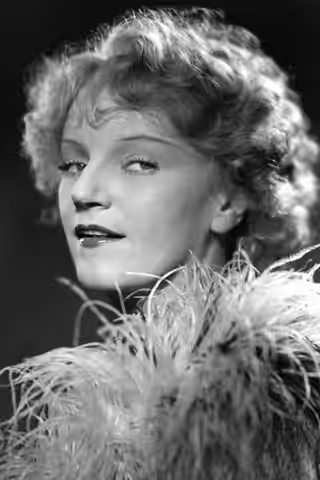
Maly Delschaft works through small gestures and changes of expression rather than grand displays of feeling. We value her restrained supporting work, while recognising that The Last Laugh gives only a narrow view of what she could do.
Fi1m perspective
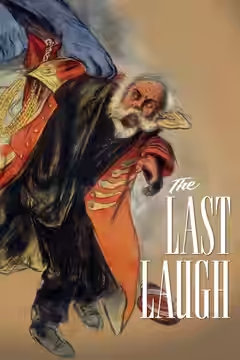
In The Last Laugh (1924), the hotel doorman’s need for respect follows him home, where Maly Delschaft plays his niece. Her part helps establish why his standing matters outside his employment. We found his humiliation painful because the domestic characters make clear that he has more to lose than his position at work. Delschaft gives the story a useful supporting presence, though this is plainly Emil Jannings’s film.
The early silent films repeatedly placed her beside Jannings: Danton (1921), The Last Laugh and E. A. Dupont’s Varieté (1925). In the last of these she is Frau Huller, the wife, a harder figure than the niece. Her understated physical acting, with its small gestures and shifts of expression, could serve both youthful and embittered characters. A leading role as the teacher in Kreuzzug des Weibes (1926) brought a breakthrough.
F. W. Murnau’s The Last Laugh is also a reminder of how much a supporting actor depends on the surrounding film. Edgar G. Ulmer’s production design makes the hotel’s hierarchy readable, while Delschaft and Max Hiller’s bridegroom show why the doorman’s standing matters at home. The film sometimes underlines the doorman’s hurt too insistently; the family’s presence already gives us a reason to care. Our recommendation rests chiefly on Jannings and Karl Freund’s cinematography, but the smaller parts help make the distress understandable.
Sound brought smaller film roles, and theatre took more of her attention in the 1930s and 1940s. Later character work included Mrs Lehmke, a landlady in Das Beil von Wandsbek (1951), and Claudia Galotti in Martin Hellberg’s Emilia Galotti (1958). These were both DEFA productions, part of a post-war screen career that continued into the early 1960s. The reduced size of the parts should not be treated as a verdict on the acting. Start with The Last Laugh, then look to Kreuzzug des Weibes for a leading role.
Biography
Maly Delschaft (born Martha Amalia Delschaft) was a German stage and film actress. She was born on 4 December 1898 in Hamburg and died on 20 August 1995 in Berlin.
After beginning in theatre, she appeared in silent films from the early 1920s. She played supporting and leading roles in productions including The Last Laugh (1924) as His Niece and Variety (1925) as Frau Huller, often alongside Emil Jannings.
During the Weimar and Nazi eras she continued in supporting roles. After the Second World War she worked in East Germany for the state-controlled studio DEFA until the early 1960s. In 1970 she received the Filmband in Gold for her life's work.