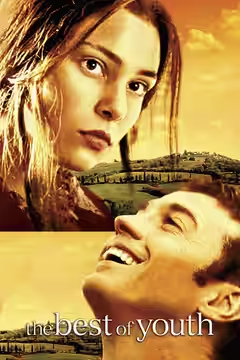
Marco Tullio Giordana makes long stretches of Italian history engrossing by letting family life take priority. We warmly recommend the patient storytelling of The Best of Youth, with a caveat about sentimentality that occasionally needs firmer handling.
Fi1m perspective
In The Best of Youth (2003), Marco Tullio Giordana lets a family's domestic difficulties occupy our attention while decades of Italian history pass around them. He allows these people time to become worth following, without rushing their troubles out of the way. Its 367 minutes are a substantial request, but the direction is patient enough to make that request seem reasonable. We cared about this family, and Luigi Lo Cascio's unforced performance was a large part of the reason.
The route to that confidence began with his feature debut, Maledetti vi amerò (1980). After features and television work through the 1980s, Pasolini, un delitto italiano (1995) brought him back to prominence. Wider recognition followed with One Hundred Steps (2000), which also gave Lo Cascio a breakthrough role. By The Best of Youth, the long family story gave Giordana room to connect private lives and public events without having to hurry through either, sustaining our interest across decades through his attention to domestic difficulties.
His recurring screenwriters Sandro Petraglia and Stefano Rulli work with him on stories that join personal lives to public events. Roberto Forza, his regular cinematographer from One Hundred Steps onwards, uses naturalistic lighting and stays attentive to actors, an approach that suits Giordana's patience. Real locations and period detail help make the family and community stories credible, but casting is at least as important. Lo Cascio gives The Best of Youth an ease that keeps a long, carefully organised drama from feeling over-managed.
The weakness appears when Giordana pushes for a feeling that the actors have already made available. The Best of Youth occasionally presses its sentiment too hard, and we would welcome more restraint at those points. It is a reservation about an otherwise engrossing film, not a reason to avoid the commitment. Later films such as Piazza Fontana: The Italian Conspiracy (2012) continue his interest in researched historical reconstruction. For a first encounter, though, choose The Best of Youth and give its family time to become your concern.
Biography
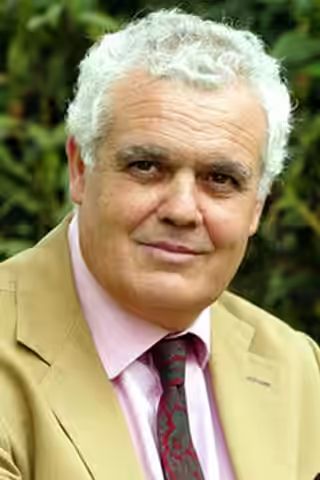
Marco Tullio Giordana is an Italian film director and screenwriter. Born on 1 October 1950 in Milan, he began working in cinema in the late 1970s, collaborating on the screenplay for Roberto Faenza’s documentary Forza Italia! (1978). His directorial debut, To Love the Damned (1980), was screened at Cannes and won the Golden Leopard at Locarno.
Giordana is known for films that engage with Italian history and social issues. These include One Hundred Steps (2000), about the murder of activist Peppino Impastato; the epic The Best of Youth (2003), which won the Un Certain Regard prize at Cannes; Piazza Fontana: The Italian Conspiracy (2012); A Woman’s Name (2018); Yara (2021); and The Life Apart (2024).