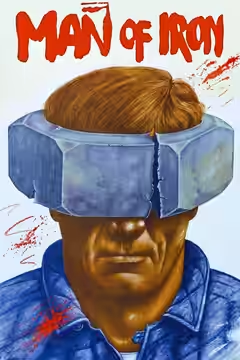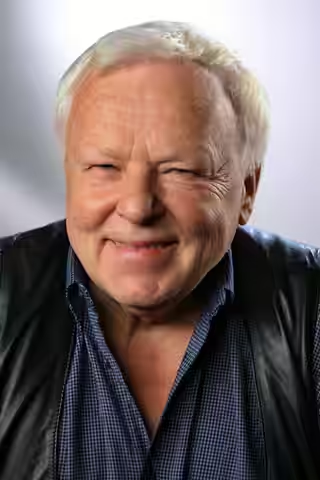
Marian Opania's trade is the compromised middle-aged man: the journalist, the official, the doctor who knows what he is doing and does it anyway. His Winkel in Man of Iron (1981) is where to start, and what the rest is measured against.
Fi1m perspective
Watch Marian Opania try to open a bottle. In Man of Iron (1981) his Winkel, a radio journalist who used to be good and now drinks, cannot get the cap off with steady hands and knows exactly what that looks like to the people watching him. Nothing is said about it. That is how Opania works: the shame arrives in the body first, in the hands and the shoulders and a voice pitched slightly too low, and the face admits it a beat later. He is a rumpled presence, and he has made a long career of rumpled men.
The career did not start there. Through the 1960s he was a young actor in young parts, a corporal in the television serial Four Tank-Men and a Dog (1966) and the lead in Skok (1967), and there was a limit to what those parts asked of him. Winkel changed that. Opania has said of the role, "Ta rola był dla mnie zaczerpnięciem drugiego oddechu", that it gave him a second breath, and it is easy to see why: Andrzej Wajda, who directed him three times, handed him a lead in which the character's failings were the point rather than a flaw to be hidden. From then on he was the man in the middle. The dean in Kieślowski's Dekalog VIII (1989), a security-service general played for laughs in Rozmowy kontrolowane (1991), Professor Nielubowicz in Gods (2014), a drama about a pioneering heart surgeon: officials, doctors and journalists deciding how far their conscience is for sale, in a country that kept changing the price.
We can only speak at length for Winkel, and Winkel is enough. The script leans on him harder than it should. He is a device for getting the story of the Gdańsk shipyard told, and people with every reason not to talk to a man from state radio sit him down and tell him twelve years of history in order. We noticed the creak and then stopped minding, because Opania made us want Winkel to get out of the film intact. That is a strange thing to feel about a drunk sent to smear a strike, and we felt it from the first scene, where the fear on him is plainer than the contempt.
The reservations are the obvious ones. His reputation stands on a handful of parts, and a good deal of the later work is popular television, above all the long run as Professor Zybert in Na dobre i na złe from 1999, rather than the cinema that made his name. He says he is more at home in dramatic parts and considers himself a serious actor, though the comic turns of the 1990s suggest he undersells himself; the general in Rozmowy kontrolowane is remembered for a reason. Start with Winkel, watch the hands, and then decide whether the man in the middle is one you want to spend more evenings with. We did.
Biography
Marian Opania is a Polish actor and singer. Born on 1 February 1943 in Puławy, he graduated from the Aleksander Zelwerowicz National Academy of Dramatic Art in Warsaw in 1964.
He has worked in Warsaw theatres including the Ateneum Theatre since 1981. Opania has appeared in more than 50 films since 1965. Notable roles include Winkel in Man of Iron (1981), the University Dean in Decalogue VIII (1989) and Dekalog (1989), and parts in Golem (1980) and Four Tank-Men and a Dog (1966). He received the Zbigniew Cybulski Award in 1970 and the Order of Polonia Restituta in 2003.