Marleen Gorris made her name with three blunt Dutch films about women who have had enough, then a warmer one that brought her international recognition. We prefer the blunt ones. Bluntness, handled this carefully, is a skill.
Fi1m perspective
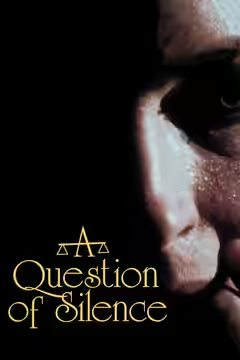
Three women who have never met walk into a dress shop and kill the owner. Nobody runs. Nobody raises a voice. They do not even look at one another, and the whole thing moves at the pace of customers deciding whether a blouse is the right blue. That is the centre of A Question of Silence (1982), and it horrified us, not for what is on screen, which is little, but for how calmly it is done. Gorris worked out on her first film that violence is most frightening when it looks like an errand.
She came to that film with no feature behind her, and made it with Dutch government money after approaching Chantal Akerman. It became the first of an informal trilogy: Broken Mirrors (1984), set in an Amsterdam brothel and told in parallel stories, and The Last Island (1990), an allegory that some found had too much allegory and not enough people. Then Antonia's Line (1995), a chronicle of a matriarchal community in the post-war Dutch countryside, which we have called warmer and more forgiving than the debut, and which brought her international recognition. She said she wanted "to give women a role that they are usually denied in family chronicles". After that came English-language adaptations, Mrs Dalloway (1997) with Vanessa Redgrave and The Luzhin Defence (2000) from Nabokov, with a man at the centre for once, then Carolina (2003) and Within the Whirlwind (2009), from Eugenia Ginzburg's memoir of the purges and the Gulag. She has since stopped making features.
Her habit is the ensemble. She does not much care for the single protagonist; she prefers a group of women and the pressures that build on them until something gives, and she is happy to break a realistic story open with cross-cutting, flashbacks or a fable's shape when it suits her. The debut borrows the courtroom picture and then refuses to stage the trial as a contest. Frans Bromet shot two of her films and Hans van Dongen cut two, and the plainness of the early work, which lets the argument stand without decoration, is partly theirs.
The argument is also the trouble. In A Question of Silence the men are one man, condescending in a single key, and the flashbacks say the same thing twice in case we missed it. Critics, many of them male, called the early work one-sided, and they were not wrong; we simply think she earns it. The later English films are gentler and were noticed less, and we suspect those two facts are related.
There is no next film to wait for. Start with the debut, and choose your company carefully, because she wrote it to start an argument and forty years on it still does.
Biography
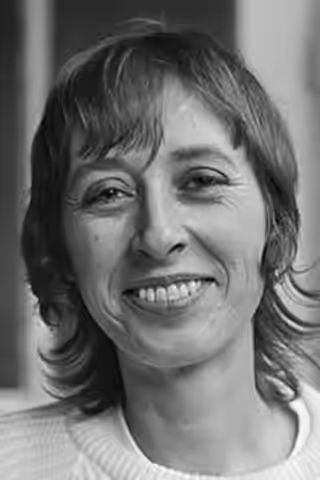
Marleen Gorris is a Dutch film director and screenwriter. She made her debut in 1982 with A Question of Silence, which she also wrote. Born on 9 December 1948 in Roermond, she studied drama at the University of Amsterdam and holds an MA in Drama from the University of Birmingham.
Gorris is best known for Antonia's Line (1995), which won the Academy Award for Best Foreign Language Film, and for adaptations including Mrs. Dalloway (1997) and The Luzhin Defence (2000). Her other feature films include Broken Mirrors (1984), The Last Island (1991) and Carolina (2003).