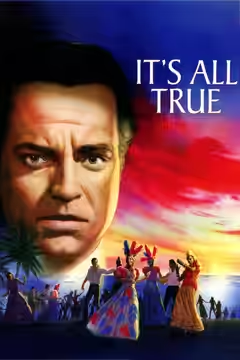
A critic first and a filmmaker once, Myron Meisel co-directed a single feature, the reconstruction of Orson Welles's abandoned Brazilian film. It is worth watching for what he and his colleagues salvaged, and it is fairer to everyone than it needed to be.
Fi1m perspective
Fishermen on a raft, filmed fifty years before anyone saw them, and between the reels a row of witnesses sitting still under even light, looking a little past the lens. That is the whole of Myron Meisel's method as a director, and it is on view in the one film he co-directed, It's All True (1993). Put the recovered thing on screen and let it run. Put the people who were there beside it and let them talk. Gary Graver shoots the interviews so plainly that nobody will notice the framing, and Ed Marx cuts the result so that 89 minutes pass without sag.
Meisel came to this from the other side of the screen. He was a founding critic at the Chicago Reader in 1971 and the Los Angeles Reader in 1978, edited and published a film magazine of his own, and wrote monographs on Blake Edwards, John Cassavetes and Michael Curtiz, an auteurist by temperament. His film work runs alongside that: writer and associate producer on I'm a Stranger Here Myself (1975), a portrait of Nicholas Ray, and executive producer on The Chaplin Puzzle (1992), which reassembled Chaplin's unreleased first feature. Then It's All True, made with Bill Krohn and Richard Wilson, Wilson having been on Welles's original shoot. After it he went back to criticism, of the theatre and opera this time. The pattern is unfinished things and the people who left them unfinished.
What the film does well is salvage. The raft footage moved us more than we expected, partly because it is beautiful and partly because we knew, watching it, how close it came to never being seen. The account of how Welles left The Magnificent Ambersons uncut and came home to find the studio had cut it for him is told clearly and by people with standing to tell it. What the film does not do is take a side. We wanted someone to be angry, and nobody is; the men who put the reels away are barely named.
Meisel has said that "first and above all, the motion picture camera is a recording device. It shows what's in front of it." That is a decent creed for the archive half of the film and a strange one for a critic, whose trade is opinion. The result is a documentary by three men who plainly admire Welles and have decided not to say so too loudly. See it for the raft, and for Wilson's memory. Do not expect it to settle the argument it lays out so carefully.
Biography
Myron Meisel is a writer, director and producer. He wrote the 1975 documentary I'm a Stranger Here Myself and contributed the story for the 1984 film The Oasis. He also worked as an artistic consultant on Barfly (1987).
Meisel co-wrote, co-directed and co-produced the 1993 documentary It's All True: Based on an Unfinished Film by Orson Welles with Bill Krohn and Richard Wilson. The film examines Orson Welles's unfinished 1940s project and received the Los Angeles Film Critics Association award for Best Non-Fiction Film, as well as a special citation from the National Society of Film Critics.