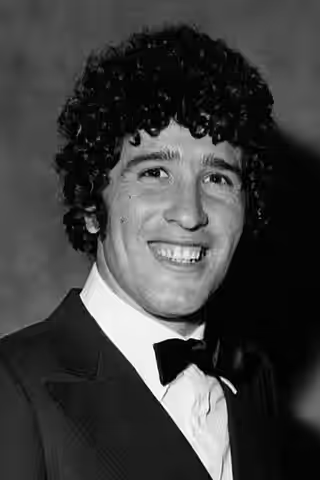
Pasolini found him as a teenager and put him in nine films as the same grinning, wide-eyed boy from the Roman borgate. It is a presence rather than a performance, and it only works when the director knows what it is for.
Fi1m perspective
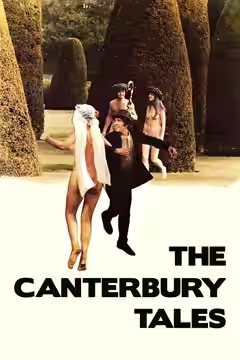
Perkin walks through The Canterbury Tales (1972) in a bowler hat with a cane, sacked from every job and chased by constables through the mud, and the walk is Chaplin's. We laughed at it, and then felt slightly ashamed, because the joke is only that Ninetto Davoli is doing Chaplin in a Chaucer film and nobody on either side of the camera seems to know why. That is Davoli in one scene: a body that is funny before it has done anything, and a director who is not always sure what to do with it.
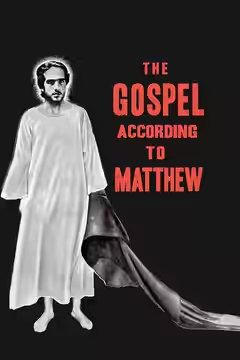
Pier Paolo Pasolini discovered him as a teenager from the borgate, with no training at all, and gave him a non-speaking part as a shepherd in The Gospel According to St. Matthew (1964). Two years later he was co-starring with Totò in The Hawks and the Sparrows (1966), and the persona was set: the innocent, the messenger, the boy who laughs at things the adults have stopped noticing. He is the angel in Oedipus Rex (1967), the messenger in Theorem (1968), Andreuccio in The Decameron (1971), Aziz in Arabian Nights (1974). Nine films with one director, and in all of them he is more or less the same person, which was the point. Pasolini wanted faces rather than technique, and Davoli has said himself that he does not consider himself an actor, because in every film he simply played himself as he is in life.
It works when the film has a use for him. Next to Totò, or to Franco Citti, the untrained laugh sits beside a trained comic's timing and the difference between the two is the joke. In the medieval and eastern settings he is the ordinary life the stories claim to be about, cheerful, physical, frank about sex, and those films are warmer wherever he happens to be standing. The trouble is that a presence cannot hold a scene the writing has given up on. Perkin is funny for a minute and then he is simply there, in a hat, and the 111 minutes around him are a slog.
After Pasolini's death in 1975 the work got lighter: popular Italian comedies, television and a long-running advertising campaign, a string of films for Sergio Citti, and now and then something heavier, such as Uno su due (2006). The returns to serious cinema, Abel Ferrara's Pasolini (2014) among them, have been occasional rather than a second career, and we do not think that is a failing. Davoli never built a part; he was a boy a director looked at and decided to film. Watch him with Totò if you can, and with Chaucer only if you have the patience for everything else in the frame.
Biography
Ninetto Davoli, also credited as Giovanni Davoli, is an Italian actor. Born on 11 October 1948 in San Pietro a Maida, Calabria, he was discovered by Pier Paolo Pasolini and made his screen debut in a non-speaking role in The Gospel According to St. Matthew (1964).
Davoli appeared in nine of Pasolini's films, often in comic or naïve roles alongside performers such as Totò. These include The Hawks and the Sparrows (1966), Oedipus Rex (1967), Theorem (1968), Pigsty (1969), The Decameron (1971), The Canterbury Tales (1972) as Perkin, and Arabian Nights (1974). He married in 1973 and has continued to work in film and television since Pasolini's death in 1975.