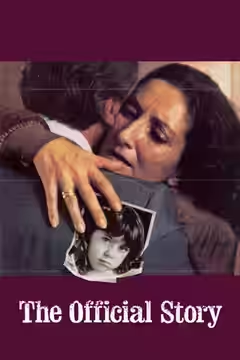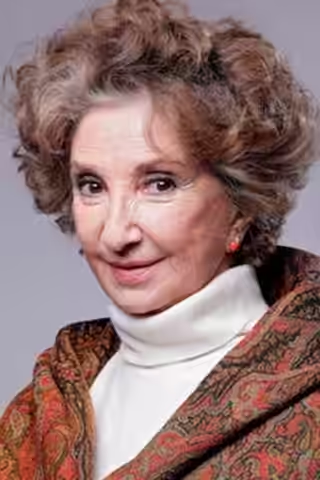
Norma Aleandro acts with her face while other people talk, and makes a comfortable woman's decision not to know look like hard work. In The Official Story that is the whole film, and few performances we have seen do as much with so few words.
Fi1m perspective
Halfway through The Official Story (1985), a friend tells Alicia what was done to her in a cell, and Luis Puenzo keeps the camera on Norma Aleandro listening. She says almost nothing. Her eyes go to the daughter she is not letting herself think about, and her hands find something to tidy. That is the performance: the gap between what Alicia knows and what she will allow herself to say, held for the length of the film with hardly any dialogue, until the words come out and she sounds surprised to hear them. It is where the film got us. We scored it 81 despite the men around her being drawn with a heavy hand, and Aleandro is most of the reason.
She was not new when she made it. Raised in a family of actors and on stage as a child, she had worked in Argentine film, television and theatre since the early 1950s, with a small part in Sergio Renán's The Truce (1974) along the way. She left the country after 1976 and came back in the early 1980s, and Puenzo's film made her name abroad at forty-nine. What followed had the shape you would expect: Hollywood supporting parts, starting with Gaby: A True Story (1987), and leads at home in Eduardo Mignogna's Autumn Sun (1996), Juan José Campanella's Son of the Bride (2001) and Jorge Gaggero's Live-In Maid (2005). We have not reviewed those and will not judge them here. The parts do tell a story, though: middle-class women, usually in a good flat, made to look at something they had arranged not to see.
What she does is listen, and let the change register before she admits it. Critics have said the same thing about her since 1986, in Madrid and in New York as well as Buenos Aires: the shifts happen in close-up, in small movements, not in speeches. She is also, by reputation, funnier than the one film we have reviewed lets on, and able to move between the grave and the light inside a single part. She has done her best work opposite men who stay in one gear. Héctor Alterio, her husband on screen more than once across five films together, and Federico Luppi, six, give her something solid to play against; Mignogna directed her twice. Near the end of The Official Story we sat through a nursery rhyme with our hands in fists, and it was Aleandro's face in the scenes before, not the song, that had put us there.
She is still working, in her late eighties and beyond: television in En terapia, one-woman shows, directing for the stage. Start with The Official Story, in Spanish with the subtitles on, because almost nothing she does there is in the lines. She has spent seventy years being asked to play women who would rather not know. Nobody has yet found the edge of how much she can tell us about that.
Biography
Norma Aleandro is an Argentine actress. She was born on 2 May 1936 in Buenos Aires to actors Pedro Aleandro and María Luisa Robledo, and is the sister of actress María Vaner. She began performing in the theatre as a child and has been active since 1952.
During the military dictatorship she was exiled, first to Uruguay and later to Spain, returning to Argentina in 1983. Her performance as Alicia Marnet in the 1985 film The Official Story brought her the Cannes Award for Best Actress. Other film roles include those in The Truce (1974), Cousins (1989), Autumn Sun (1996), The Lighthouse (1998), Son of the Bride (2001) and Cama Adentro (2005). She received Academy Award and Golden Globe nominations for her supporting role in Gaby: A True Story (1987).