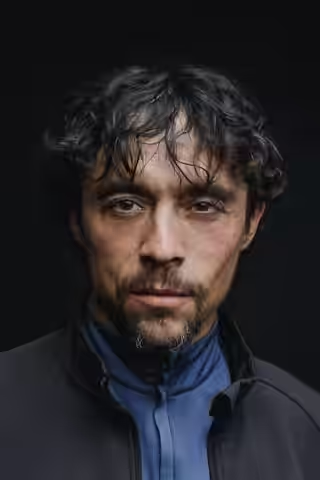
Osvaldo Sánchez spent a quarter of a century on stage before anyone pointed a camera at him, and it shows: he can sit in silence and let a scene run on his hands and his eyes. On the strength of On the Road, we want to see more.
Fi1m perspective
For long stretches of On the Road (2026), Osvaldo Sánchez does not say anything. His trucker, El Muñeco, talks to the engine sooner than to a person, and when Veneno (Victor Prieto Simental) climbs into the cab, Sánchez plays the first hours of their acquaintance as a man deciding whether to look. He checks the mirrors. He drives. When the look comes it is wary, and it plainly costs him, and you can read the cost without a line being spoken. That is a stage actor's instinct, holding a scene with the body while the words stay put, and it is a large part of why the film works.
He came to film late. Sánchez began acting in 1999 and spent the next two decades in theatre: more than seventy productions as actor, set designer and lighting designer, much of it with Compañía Teatral del Norte. Short films followed from 2017, and features only in 2024, with Jacinto in Correr para Vivir and Florencio in Rodrigo Prieto's Pedro Páramo, a part that exists mostly as memory and has very little to say. Then David Pablos, who wrote On the Road as well as directing it, gave him the lead, and the screen career properly starts there. We have reviewed one of these films, and scored it 80. That is the honest size of the record.
He prepares like a man who does not trust himself to fake it. For El Muñeco he got a licence and spent three weeks driving the roads of Michoacán, sleeping in the trailer, on stretches of five days without rest, to find out what the work does to a body. Actors like telling interviewers this sort of thing and it usually makes no difference on screen. Here it does. He sits in the cab as if he has been in it since Tuesday, and the tiredness is in his shoulders before the script mentions it.
What moved us, more than we expected from a film so frank about sex and so quick to violence, was noticing what happens in the bunk. Those are the only scenes in which either man stops checking the mirrors, and Sánchez plays them as a man who has, for a few minutes, forgotten to be afraid. The film does not point this out. He does it, quietly, and lets us catch it or not.
The caveat is the record. One lead, two supporting parts, and a stage career we cannot see from here. His screen roles so far are all of a piece: solitary, working-class Mexican men with hard lives and not much to say, and he is so far known mainly as a theatre actor who has only just arrived. Whether anyone will ask him to do something else is the open question. Still, few actors reach their first lead already knowing how to do nothing on camera and make it read. We want to see what he does with a part that requires him to talk.
Biography
Osvaldo Sánchez Valenzuela is a Mexican actor of film and theatre. Born in Mexicali, Baja California, he was raised in Hermosillo, Sonora. He began his career in 1999 through the Programa Nacional de Teatro Escolar and graduated with a bachelor's degree in theatre from the University of Sonora, having also studied graphic design at the Universidad del Noroeste.
He has worked primarily in theatre for over twenty-five years, appearing in more than seventy productions as an actor, set designer and lighting designer. For over a decade he was a member of the Compañía Teatral del Norte. In 2011 he received the award for best actor at the Festival Internacional de Teatro Universitario at UNAM for the play Arlequino.
His film credits include Jacinto in Correr para Vivir (2024), Florencio in Pedro Páramo (2024) and El Muñeco in On the Road (2025). He received an Ariel Award nomination for best actor for the latter and has appeared in earlier short films including Loving South (2017).