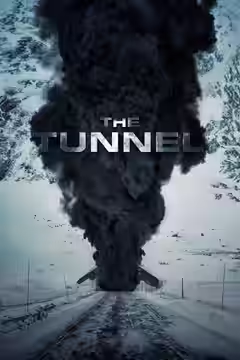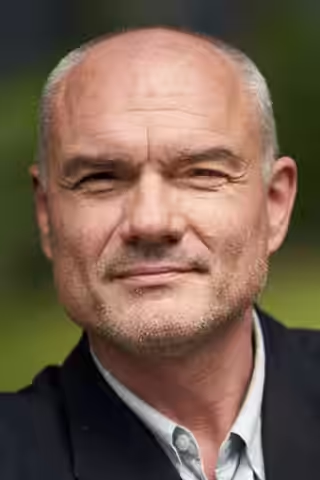
Pål Øie makes Norwegian genre films in which the place does most of the frightening: a forest, a house in the trees, a road tunnel full of smoke. The atmosphere is nearly always sound; the people and the endings are where he comes unstuck.
Fi1m perspective
Put Pål Øie somewhere remote and Norwegian and he knows what to do. A forest in Dark Woods (2003), a house among the trees in Hidden (2009), an abandoned asylum in Dark Woods II (2015), a road tunnel filling with smoke in The Tunnel (2019). He lets the setting do the work: the camera waits, the sound closes in, and the shock, when it comes, is late and small. He has said he likes to build the atmosphere "because if you wait a little, the end will be so much stronger." The first half of that sentence he can deliver. The second half has been the problem for twenty years.
He came up through short films in the 1990s and early 2000s and arrived with Dark Woods, which he wrote as well as directed and which helped set off a run of Norwegian horror shot in the countryside rather than the city. Hidden followed, a psychological piece about an inherited past in a forest house, then the asylum sequel. With The Tunnel he left horror proper for the disaster film, and with Kraken (2026) he moves on to the monster film, putting the kraken back in the fjords it came from. There are documentaries in between, including a 2019 film about the painter Astrup, and the documentary habit shows: he is happier watching a place than explaining a person.
The Tunnel is the film of his we have reviewed, and we gave it 54. Kjersti Helen Rasmussen's script follows the genre's rules to the letter, a small town, a holiday, a man who knows the ground, a child in the wrong place, a lorry that should not have been on the road, and at 103 minutes it is short for the form, which helps. Øie does the fire, the smoke and the cold with real conviction. We were tense for the first hour, and we noticed the exact moment the tension left: it went when the film stopped being about the tunnel and started being about the family, whose troubles we had seen in a dozen other disaster films and did not need to see again.
That complaint has followed him. Reviewers found Dark Woods familiar in its plotting, Hidden brooding to a fault and flat in its last act, and the sequel more conventional than the original. We have not looked at those closely enough to argue; we can say The Tunnel fits the pattern without a gap. What holds the films together is Sjur Aarthun, cinematographer and editor on five of them, whose controlled, dark-and-light compositions in the later work are as much his as Øie's, and Rasmussen, who has written three.
If you want an hour of a confined Norwegian place turning hostile, he is reliable, and the first hour is usually the one to stay for. If you want to care who gets out, bring your own reasons. Kraken may suit him better than anything yet; a sea monster, at least, does not come with a family drama attached.
Biography
Pål Øie is a Norwegian film director and writer. He was born on 15 November 1961. He trained in documentary film at Høgskulen i Volda and in television production at the University of Bergen.
Øie began his career with short films and documentaries before making his feature debut with Dark Woods (Villmark, 2003). He is also known for directing and writing Hidden (Skjult, 2009), Dark Woods II (Villmark 2, 2015) and The Tunnel (Tunnelen, 2019). He has directed the forthcoming film Kraken (2026).
He is a co-owner of the production company Handmade Films In Norwegian Woods.