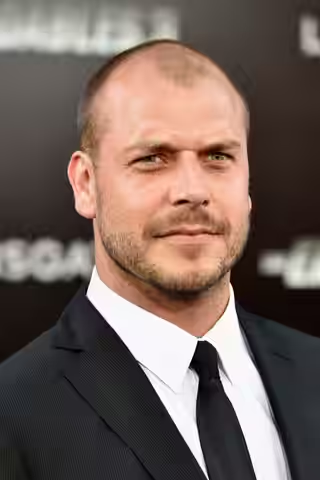
Patrick Hughes builds action the old way: real ground, real stunt performers, a camera that always knows where everyone is. What he has not yet built is a person worth following through it, and War Machine is both of those things at once.
Fi1m perspective
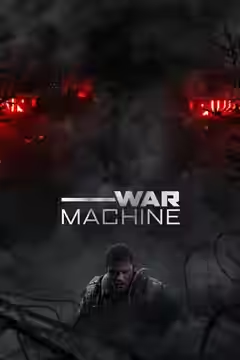
A man goes left in a Patrick Hughes fight, and when we next see him he is still on the left. That sounds like a small thing to praise, and in the current run of action films it is not. Hughes stages on real locations, puts stunt performers rather than software in harm's way, and cuts so the geography holds. In War Machine (2026) Aaron Morton shoots the exercise ground so it looks like ground, and Andy Canny's editing keeps the squad in the same place from one shot to the next. The five-minute chase in the middle of that film is the best thing he has put in front of us, and it is good because we always know who is running from what.
He came to it the hard way. After film school in Melbourne he spent a decade on shorts and commercials, could not get anyone to option his scripts, and paid for his own first feature, Red Hill (2010). Sylvester Stallone saw it and handed him The Expendables 3 (2014), and the Hollywood run followed: two Hitman's Bodyguard films (2017, 2021) and The Man from Toronto (2022), all built to run a fight and a quarrel at the same time. In 2021 he set up his own company, Huge Film, with Greg McLean and James Beaufort, and War Machine is the one he has directed, co-written and co-produced under it.
What works is the action, and Hughes knows why. He has said that any stunt gets broken down into story form first, asking what the object of desire is, and you can see it on screen: the machine wants the squad, the squad wants the tree line, and the chase is a straight argument between the two. What does not work, so far, is the part before and after. War Machine spends half an hour on men being shouted at, calls them 7 and 15 and 44, and dresses them alike, so that when they fall the losses register as arithmetic. We were bored through that opening, in the particular way of being told to admire something, and then the machine arrived and we sat up with it. Alan Ritchson holds the film by doing almost nothing, and he is filling a gap the script left rather than one it planned.
Hughes has the tools most of his contemporaries have mislaid: he can stage, he can cut, and he does not hide behind a computer. Whether he can write someone we would mind losing is the open question, and the writing credit on War Machine says he means to answer it himself. If the next one gives its recruits surnames, we will be there for the chase.
Biography
Patrick Hughes is an Australian film director, screenwriter and producer. He was born on 13 May 1978 in Black Rock, Victoria, and graduated from the Victorian College of the Arts in 1999.
Hughes began with short films, including Signs (2008). His feature debut was the 2010 western thriller Red Hill, which he also wrote and produced. He subsequently directed The Expendables 3 (2014), The Hitman's Bodyguard (2017), The Hitman's Wife's Bodyguard (2021) and The Man from Toronto (2022).
Hughes directed, co-wrote and co-produced the 2026 science-fiction action film War Machine.