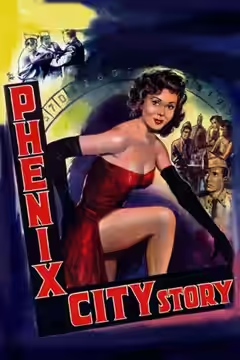
Phil Karlson makes intimidation feel ordinary enough to be frightening. We value the blunt conviction of his crime films, but The Phenix City Story also shows how readily his forceful direction can disguise weaknesses in the writing.
Fi1m perspective
With Edward Andrews on screen in The Phenix City Story (1955), corruption feels like an everyday business. Karlson gives the intimidation a credibility that makes its violence difficult to dismiss as entertainment. Across his crime films, he returns to individuals confronting organised corruption or betrayal. We were unsettled by the confrontations in The Phenix City Story because the bullying felt so plausible. It is good, bruising work, though the storytelling does not always deserve the same confidence.
He began directing features in 1944, making programmers for Monogram/Allied Artists, before finding his strongest territory in the crime films of the early 1950s. Kansas City Confidential (1952) brings brutal violence to a caper; 99 River Street (1953) follows an ex-boxer through a night of betrayal. The later work moved through Westerns and war films, with Gunman's Walk (1958) examining father-son conflict. The commercial assignments of the 1960s offer less reason to follow him indiscriminately. Walking Tall (1973) returned him to a fact-based story of vigilante violence.
Karlson favours close-ups and direct physical violence, with relatively little dependence on tilted angles or heavy shadows. Cinematographer Burnett Guffey and leading actor John Payne were recurring collaborators. In The Phenix City Story, location shooting and documentary elements support the everyday credibility of the threats. Those choices matter because a film about organised corruption needs to convince us that people actually live under it, rather than simply provide a succession of unpleasant incidents.
The difficulty is his willingness to keep pressing the ugliness after it has made its point. In The Phenix City Story, forceful presentation sometimes replaces the steadier account of the community that the writing ought to supply. Andrews and McIntire help through the slack stretches, but we wanted the story to develop with the conviction of its strongest encounters. Start with this film, and give Andrews your full attention.
Biography
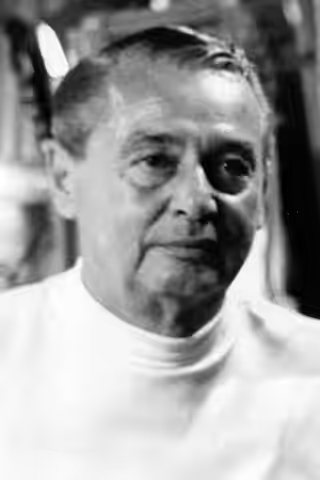
Phil Karlson (born Philip N. Karlstein) was an American film director. He directed a series of tough, realistic crime films in the 1950s, including Kansas City Confidential (1952), 99 River Street (1953) and The Phenix City Story (1955).
Karlson was the son of Irish actress Lillian O'Brien. He studied painting at the School of the Art Institute of Chicago and law at Loyola Marymount University. He entered the film industry as a prop man while a student and later worked as an assistant director before directing his first feature in 1944.
His later credits include Gunman's Walk (1958), The Young Doctors (1961), Kid Galahad (1962) and the commercially successful Walking Tall (1973). The Phenix City Story was selected for preservation in the National Film Registry.