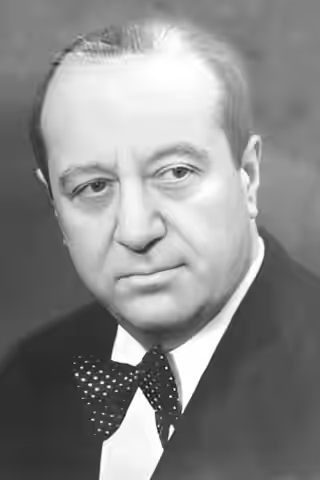
Raimu makes foolish men worth caring about without making them respectable first. We value the way his comedy lets a character remain ridiculous even after we have begun to feel his distress.
Fi1m perspective
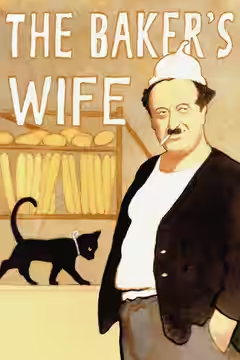
In The Baker’s Wife (1938), Raimu lets Aimable Castanier look ridiculous without treating his unhappiness as a joke. The baker’s foolishness remains visible when he is hurt; nothing in the performance demands that we suddenly consider him a wiser man. We were moved by his distress because Raimu kept the comic awkwardness that had made us laugh. Marcel Pagnol gives him permission to be absurd and takes the pain seriously, a combination on which much of the film depends.
His work drew on music hall and boulevard theatre, with expressive gestures and a voice that could drop from a boom to a whisper. The important screen turn came with the part he played in Pagnol’s 1929 stage production of Marius and took into Alexander Korda’s film, Marius (1931). Fanny (1932) continued the Marseille trilogy, which concluded in 1936. Across the café owners, bakers and well-diggers that recur in his work, regional speech and bluster make the men distinct before their vulnerability becomes apparent.
Pagnol gives that talent plenty to do in The Baker’s Wife, though the film also shows the limitations of relying on it. Georges Benoît’s conservative cinematography seldom contributes much beyond making space for the actors, and some of the village humour wears thin. Raimu keeps us interested when the images do not. The care in his performance is more consistent than the filmmaking around him.
The partnership did not account for all his screen work. Julien Duvivier’s ensemble drama Un carnet de bal (1937) and Henri Decoin’s Les Inconnus dans la maison (1942) took him outside Pagnol’s films. Between them came a Provençal father, Pascal Amoretti, in The Well-Digger’s Daughter (1940). These parts suggest a useful way of following him: attend to how the voice and gestures change with the man, rather than counting departures from comedy.
The risk with so forceful a performer is that weaker material survives on his work alone. The Baker’s Wife sometimes needs that help, but Aimable is allowed enough embarrassment to stop the affection becoming cosy. Raimu does not require us to approve of the baker before we can be concerned for him. Start there, provided a performance can be reason enough for your evening.
Biography
Raimu, born Jules Auguste Muraire, was a French actor. He was born on 18 December 1883 in Toulon and died on 20 September 1946 in Neuilly-sur-Seine. He began his career in music hall and made his stage debut in Toulon in 1899 before moving to Paris.
He gained acclaim for creating the role of César in Marcel Pagnol's stage play Marius in 1929 and reprised it in the film trilogy Marius (1931), Fanny (1932) and César (1936). He also starred as Aimable Castanier in Pagnol's The Baker's Wife (1938) and appeared in The Well-Digger's Daughter (1940).