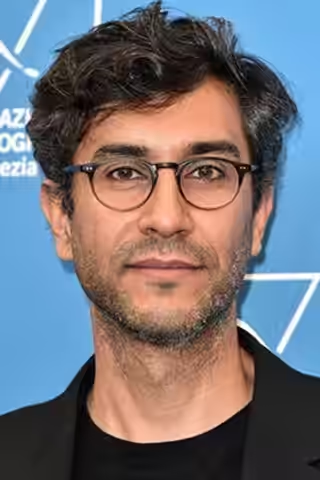
Ramin Bahrani is an editor who notices how much effort obedience takes. His work can be brisk and bitterly funny, though The White Tiger suggests he could be firmer about cutting his own explanations.
Fi1m perspective
In The White Tiger (2021), Balram Halwai wants to escape poverty, but obedience remains a habit he struggles to discard. Bahrani pays attention to the effort involved in serving other people, particularly those who barely notice the power they have. As co-editor with Tim Streeto, he gives the early stretches enough pace to carry a substantial amount of explanation. It is good, bitterly funny work, attentive to human behaviour even while there is considerable information to get through.
Bahrani edited his first feature, Man Push Cart (2005), and continued to cut the films he wrote and directed with Chop Shop (2007) and Goodbye Solo (2008). Those early films favoured real locations and non-professional performers. The working day mattered, as did the places in which it was spent. Long takes allowed everyday routines to occupy the screen. Cinematographer Michael Simmonds, an early collaborator, supplied unobtrusive compositions that suited these character-led films.
The move towards larger-scale stories, through At Any Price (2013) and 99 Homes (2015), retained his interest in work and moral compromise. He also edited 99 Homes, continuing to shape the material after writing and directing it. In The White Tiger, his adaptation of Aravind Adiga’s novel, the difficulty of doing all three jobs becomes apparent: the editing keeps material lively that the writing has begun to repeat.
We were angered by the humiliations in The White Tiger, because Bahrani makes us notice how casually the people being served impose them. Adarsh Gourav’s absorbing performance gives that anger someone specific to care about. The music by Saunder Jurriaans and Danny Bensi sustains the unease, while the rap-heavy soundtrack makes the pursuit of wealth sound attractive.
The middle is less convincing. Streeto and Bahrani cannot keep the pace up when the screenplay repeats its points, and the narration sometimes explains what the performances already convey. We would like him to leave more of those explanations out. Start with The White Tiger; Gourav is worth staying with through the slower passages.
Biography
Ramin Bahrani is an American director, screenwriter and producer. He was born on 20 March 1975 in Winston-Salem, North Carolina, to Iranian immigrant parents, and graduated from Columbia University in 1996. He later studied filmmaking in Iran and has served as a professor of film directing at Columbia University's School of the Arts.
Bahrani's early feature films include Man Push Cart (2005), Chop Shop (2007) and Goodbye Solo (2008). He is also known for At Any Price (2012), 99 Homes (2015) and the Netflix adaptation The White Tiger (2021), on which he served as director, writer and editor. Other credits include directing the television film Fahrenheit 451 (2018).
Bahrani received the 2009 Guggenheim Fellowship. In 2021 he was nominated for the Academy Award for Best Adapted Screenplay for The White Tiger.