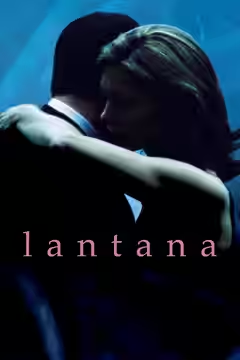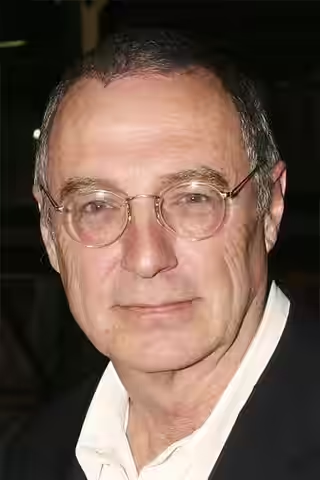
Ray Lawrence gives unhappy adults time to say too little and hurt one another. We value the performances his patience allows, especially in Lantana, even when the plotting strains and the pace becomes heavy.
Fi1m perspective
In Lantana (2001), Anthony LaPaglia's detective Leon Zat brings his private unhappiness into the investigation. Lawrence lets that unhappiness occupy scenes a brisker crime drama would cut short. The case gives people reasons to examine one another, and their private grievances make that examination uncomfortable. Kerry Armstrong's Sonja Zat is just as important; the film does not treat her troubles as background to his. We were moved by the two of them because their resentment feels settled in, without an easy way out.
Bliss (1985), his first feature, was co-written with Peter Carey from Carey's novel. Lawrence continued directing commercials during the sixteen-year gap before Lantana, which was adapted from Andrew Bovell's play Speaking in Tongues. With Jindabyne (2006), he turned to Raymond Carver's short story So Much Water So Close to Home, moving it to rural Australia. Across those three features, he keeps returning to trust, guilt and the trouble people have talking to one another.
Lawrence favours natural light and one-take shooting. His collaborators have included cinematographer Mandy Walker and editor Karl Sodersten; the aim is to keep the technique unobtrusive and the actors central. In Lantana, LaPaglia's rawness makes Leon difficult to regard simply as the man who will solve the case. That is where Lawrence's patience pays off: we have to consider the person asking the questions.
Bovell's screenplay supplies the connections between these unhappy adults, and Lawrence takes their grievances seriously enough to make the investigation uncomfortable. Some of those connections feel forced, however, and the deliberate pace can grow heavy. That is a real limitation in a film which depends on our accepting how these lives cross. The performances keep the emotional consequences convincing even when the plotting is contrived. Start with Lantana for LaPaglia and Armstrong, provided a crime drama can hold your attention without hurrying to solve the crime.
Biography
Ray Lawrence is an Australian film director. Born in London, England in 1948, he moved to Australia with his family at the age of 11.
He began his career in advertising and television commercials before making his feature debut with Bliss (1985). His subsequent films are Lantana (2001) and Jindabyne (2006). Lawrence is known for working at a measured pace, completing only three features over several decades, and for his continued work directing commercials.