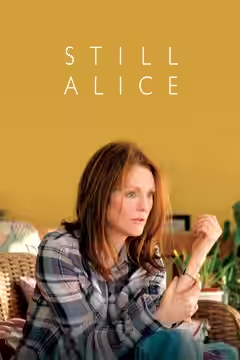
Richard Glatzer gives people on the margins his full attention. We value his work with actors, especially in Still Alice, though the patient, sympathetic approach can leave difficult stories feeling more familiar than they should.
Fi1m perspective
Julianne Moore's Alice is someone to listen to, and Richard Glatzer's direction gives her that attention. In Still Alice (2014), made with co-writer and co-director Wash Westmoreland, her intelligence remains central to the account of her experience of Alzheimer's. The film is moving, despite its conventional storytelling. Glatzer's strength is the care he takes with a character who could so easily become a means of teaching everyone around her compassion.
The earlier films find people trying to live within particular communities. His solo feature debut, Grief (1993), is a comedy-drama behind the scenes of a daytime television show, drawn from his own production experience. The Fluffer (2001), his first feature with Westmoreland, looks at obsession and power in the gay pornography industry. In Quinceañera (2006), the focus moves to a Mexican-American family and gentrification in Echo Park. The change of setting is considerable; the interest in belonging is consistent.
The working methods matter here. Quinceañera uses location shooting and local casting to give its neighbourhood convincing detail, while handheld camerawork brings a documentary-like looseness. Glatzer and Westmoreland's shared writing and directing credits also matter: we should be wary of assigning the partnership's decisions to one man. Their adaptation of Lisa Genova's novel in Still Alice keeps that attention to people, though the filmmaking is more familiar than the performance deserves.
We were moved by Moore's scenes with Kristen Stewart, because their exchanges give the restrained drama an emotional force its cautious writing does not consistently earn. That is also the limit of our praise: too much rests on the actors making conventional material feel specific. The concern for Alice herself is sound, and keeping her worth listening to as listening becomes difficult is an important directorial choice. Start with Still Alice for Moore and Stewart, without expecting the storytelling to surprise.
Biography
Richard Glatzer (1952–2015) was an American film director and screenwriter. He frequently collaborated with his husband Wash Westmoreland, with whom he co-directed and co-wrote four feature films.
Glatzer was born in Flushing, New York, and studied at the University of Michigan and the University of Virginia. He began his career in reality television before directing his first feature, Grief (1993). With Westmoreland he made The Fluffer (2001), the Sundance award-winning Quinceañera (2006) and The Last of Robin Hood (2013). Their final film together was Still Alice (2014), adapted from Lisa Genova’s novel; Glatzer was diagnosed with ALS shortly before work began and completed the project despite his illness. He died in Los Angeles in 2015.