Robert Thorogood writes murder as a game the viewer can win: a body, a handful of suspects, a detective who explains everything at the end. Death in Paradise ran on it for years; The Marlow Murder Club lets the explaining take over.
Fi1m perspective
Every Robert Thorogood mystery ends in the same room. The detective gathers the suspects and then, one by one and at some length, tells them what happened. It is the oldest scene in the genre and he has never been embarrassed by it. He has said: "You must play fair with the viewer. There’s always the moment when the detective solves the crime. At that moment, the viewer should be able to press pause, play along at home, and solve it too." That is the whole method: a clean death, a small cast, clues left in plain sight, and a final speech that pulls nothing from a hat.
He got there slowly. There were years of scripts nobody bought and a single Radio 4 play, and then in 2008 he entered a competition with a pitch he called a copper in the Caribbean. That became Death in Paradise (2011), which he created, wrote many of the early episodes of and still executive produces. Crime drama at the time was going Scandinavian and dark, and Thorogood went the other way: a sunlit island, a detective with a grudge against the sun, a body with no blood on it. Early reviewers called the characters caricatures and the plots formulaic. Audiences did not mind, and the show has since produced Beyond Paradise (2023) and Return to Paradise (2024). Trackers (2019), an organised crime thriller adapted from Deon Meyer, is the one time he has worked outside the puzzle.
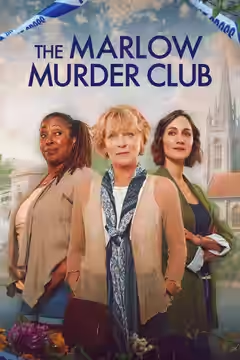
The Marlow Murder Club is the second franchise, and it took the hard way round. Nobody wanted it as a series in 2015, so he wrote it as a novel in 2021 and adapted that in 2024, giving Samantha Bond, Jo Martin and Cara Horgan a pretty river town and a murder to share. He chose to spread each case across two episodes so there would be more talk around the case, and that is exactly what went wrong. Judith finds a clue, explains it to Suzie, Suzie repeats it to Becks, and the three of them lay it out for Malik. Halfway through the second episode we were ahead of all four of them and waiting, and the waiting made us fond of the women and cross with the script. He has called the one-hour form the hardest television to write, because the murder and the solution eat twenty pages before the fun starts. Marlow suggests those twenty pages were doing him a favour.
What holds up across all of it is the construction. His clues hold, his endings play fair, and his tone is kind to everyone, the murderer included. What does not hold up is character. Judith is formidable because we are told she is, and Death in Paradise drew the same complaint a decade earlier. The second and third series of Marlow run to six episodes each, so somebody noticed the shape was wrong. Give him an hour and a corpse and he will use every minute. Give him two and he will spend the second telling you about the first.
Biography
Robert Thorogood is an English screenwriter and novelist. He created the BBC One murder mystery series Death in Paradise (2011–), for which he also wrote episodes and later novels, and co-created the spin-offs Beyond Paradise (2023–) and Return to Paradise (2024). He created the South African series Trackers (2019) and wrote the novel series The Marlow Murder Club, beginning with the 2021 book of the same name.
Born in Colchester, Essex, Thorogood studied history at the University of Cambridge. After years working in temporary jobs while writing, he pitched Death in Paradise successfully following a writing competition. He later settled in Marlow, Buckinghamshire, which inspired his Marlow Murder Club novels; he adapted the first for the 2024 UKTV and PBS series, serving as creator, writer and executive producer.