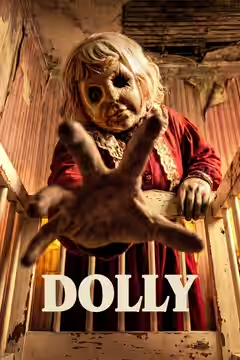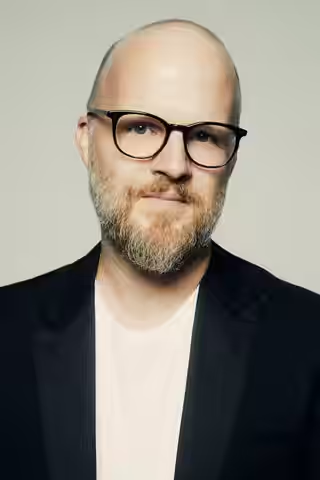
Rod Blackhurst makes lean genre pictures on real film stock that wear their influences on the sleeve, and the look is never the problem. In Dolly the trouble started once the first killing was over and the film had to think of something else.
Fi1m perspective
The first killing in Dolly (2026) is done with practical effects and no cutaways, on 16mm stock that makes the blood look like paint on a wet wall. We flinched, properly, and in a film so plainly built out of The Texas Chain Saw Massacre we had not expected to. That is Blackhurst's method in one scene: take a thing horror did in 1974, do it again with the real materials, and trust the grain to carry it. For ten minutes it does.
He came to features sideways, through commercials and ski films and then documentary. Amanda Knox (2016), which he co-directed and produced, got the principals of that case on camera, which is the hard part of that kind of film. The same year Here Alone was a post-apocalyptic drama made on almost no money, and there was then a long gap, filled with true crime for television, before Blood for Dust (2023), a crime thriller made through Witchcraft Motion Picture Company, which he runs with Noah Lang from Nashville. A short he directed became the basis for Blumhouse's Night Swim (2024). It is a working filmmaker's career, and outside the festivals the reviews have mostly been modest.
What he does well is the surface. Justin Derry's photography on Dolly turns the woods into a green-brown smear and the night into something with no back wall; Nick Bohun's dirty drone of a score is right for the picture. The isolation, the survival, the moral murk that run through his documentaries and his fiction are all there in the frame. What he does less well is the middle. Dolly has one idea about motherhood, stated in the first reel, and Blackhurst and his co-writer Brandon Weavil then walk it in circles for eighty minutes, capture and escape and recapture, while Justin Oakey cuts as if there were more story to get through than there is. Seann William Scott, who can do panic and comedy at once, is used as a body to be moved about. We were bored, and then cross about it, because the opening had promised better.
He has said of his approach, "Wear your influences openly, but metabolize and integrate them." On the evidence of Dolly he has managed the first half. He can assemble a crew who know what to do with film stock and rusting metal, and he can stage a death that makes a room go quiet. What he has not yet shown us is a second act to put behind it. We will watch the next one for its opening ten minutes, and hope the eleventh has something new in it.
Biography
Rod Blackhurst is an American filmmaker, director, writer and producer. He made his narrative feature debut with Here Alone (2016), which won the Audience Award for Best Narrative Feature at the Tribeca Film Festival. He co-directed the Netflix documentary Amanda Knox (2016), which received Emmy and Critics' Choice nominations.
Blackhurst directed the crime thriller Blood for Dust (2023) and co-wrote the story for the Blumhouse horror film Night Swim (2024), which originated from a short film he made with Bryce McGuire. He wrote, directed and produced the horror film Dolly (2025), released theatrically in 2026. He operates the production company Witchcraft Motion Picture Company with Noah Lang and is based in Nashville.