Rod Lurie makes tense dramas about people under institutional pressure. We value his seriousness, but his weakness for moral speeches can make watching people face difficult choices feel more dutiful than it should.
Fi1m perspective
Lurie often lets dialogue scenes run in long takes, panning between speakers rather than relying on brisk cutting. He is interested in people being pressed to defend a decision, and he can make that pressure tell. We find him less persuasive when the defence becomes a lecture. His first feature, Deterrence (1999), put a nuclear crisis at the centre of a political thriller; The Contender (2000) followed with a vice-presidential nominee facing scandal. The performances in the latter give the dilemmas force, though the speeches can labour the point.
The Last Castle (2001) moved into a military prison, while Nothing But the Truth (2008) built a thriller around a journalist's protection of a source. The source-protection story is particularly well suited to his interest in professional ethics: keeping quiet can itself become the difficult choice. Across his work, his recurring collaborators include producer Marc Frydman and cinematographer Alik Sakharov. We are more interested in the strain these situations put on people than in another explanation of the principles involved.
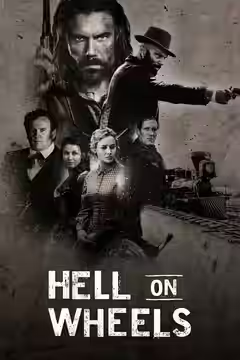
Hell on Wheels (2011) offers only patchy pleasures, despite its railway Western setting and lively supporting cast. We grew impatient with the solemn dialogue, which made the uneven pace harder to forgive. Lurie directed three episodes between 2012 and 2015, and it would be unfair to treat a judgement on the whole series as a verdict on those instalments. Still, this is not where we would send someone looking for a persuasive introduction to his direction. There is enough life in the supporting performances to make the heaviness elsewhere frustrating.
The Outpost (2019) takes his interest in pressure into combat, where his immersive staging has a more immediate purpose. The battle scenes are forceful, though the character development is thinner than it needs to be. That is a different frustration from the speeches, and a useful change of emphasis. Try it for the combat, rather than for a rounded account of everyone caught in it.
Biography
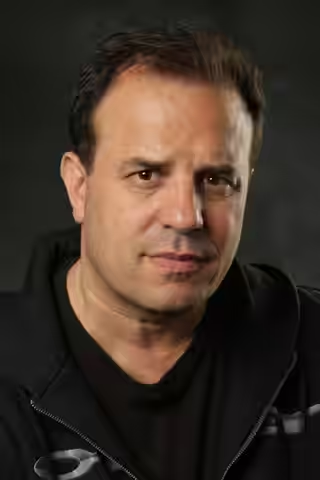
Rod Lurie is an Israeli-born American film director, screenwriter and former film critic. Born on 15 May 1962 in Israel, he graduated from the United States Military Academy at West Point in 1984 and served in the US Army before entering journalism.
He worked as an entertainment reporter and film critic for publications including the New York Daily News, Premiere and Los Angeles Magazine, and hosted a radio film review show. Lurie began directing with the feature Deterrence (1999). His credits include The Contender (2000), The Last Castle (2001), Nothing But the Truth (2008), Straw Dogs (2011) and The Outpost (2020). He has directed episodes of series including Hell on Wheels (2011), Commander in Chief (2005) and American Odyssey (2015).