One feature in, Ronan Corrigan has a subject and a method: crimes on screens, told in the small, dull, dangerous steps real ones take, with the jokes the culprits send each other. What he has not yet shown is that he can sustain one.
Fi1m perspective
A cursor hovers over a button and does not click. A message shows as read and nobody replies. These are the moments Ronan Corrigan builds LifeHack (2026) out of, and they are the best argument for him. He treats a break-in as a series of small, dull, dangerous steps, and he can get real tension out of a password field, which is more than most heist films manage with a vault.
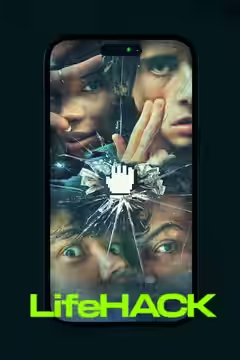
He came to features by way of music videos, commercials and a 2018 documentary, Soft Boy Forever, about the Dublin hip-hop collective Soft Boy Records, made while he was working out of London after Derry. LifeHack was written in lockdown, out of his own hours in front of a gaming PC, and produced with Timur Bekmambetov, who has been pushing the screenlife format since Unfriended and Searching. Corrigan's own description of it is "Ocean’s 11 on a Discord server", and for an hour that is exactly what it is: four friends, Georgie Farmer's Kyle Peters chief among them, stealing a great deal of cryptocurrency without leaving their bedrooms.
What he does well is the talk. The chat windows are full of the jokes these people would actually send each other, and Corrigan and his co-writer Hope Elliott Kemp, who has worked with him on shorter things, know the difference between a meme that is funny and a meme that is merely recognisable. We laughed a good deal in the first half hour, and once at something we felt we probably should not have. Angela Mulhern's production design lives inside the desktops, in wallpapers and cluttered downloads folders, and tells you who these people are faster than dialogue could. Ciaron Craig makes webcams look like webcams, which is harder than it sounds.
The edit is where a screenlife film lives or dies, and Corrigan cut this one himself alongside Sasha Kletsov, Anthony Le and Anton Kudrov. For an hour they know which window to enlarge and how long to let a message sit unread. Then the windows pile up, the pace stops being a pleasure and we found ourselves watching a progress bar. The picture is 97 minutes long and has about 70 minutes of ideas, and the plot, once the theft is under way, cannot carry what has been loaded onto it. We scored it 67: good, not more, and the shortfall is in the writing rather than the method.
His second feature is to be a horror set in Derry and Donegal, which is to say outside the desktop, with weather and hills and a camera that has to be pointed at something. Everything in LifeHack that impressed us came from knowing how a window behaves. We would like to see what he does with a door.
Biography
Ronan Corrigan is an Irish director, writer and editor. He is based in London and originally from Derry.
He began working in commercials and music videos, including projects for artists such as The Academic and The Snuts. His short documentary Soft Boy Forever (2019) was nominated at the UK Music Video Awards. He has also worked as a creative editor for Netflix UK’s Writers Room and was selected for the BAFTA x BFI CREW programme in 2021.
Corrigan wrote, directed and edited his debut feature film LifeHack (2025), a screenlife heist thriller co-written with Hope Elliott Kemp and produced by Timur Bekmambetov. The film premiered at SXSW in the Narrative Spotlight section.